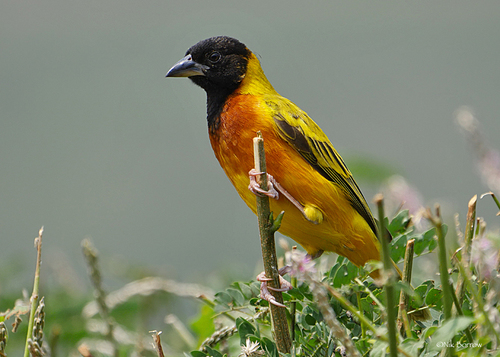
Black-headed Weaver
Ploceus melanocephalus
A master architect of the wetlands, the Black-headed Weaver is famous for its intricate hanging nests and vibrant golden plumage. Whether they are chattering in a colonial reedbed or splashing in a garden pond, these energetic birds are a highlight of any backyard camera feed.
Quick Identification
Size
13-15 cm (5-6 in) in length; wingspan of approximately 22 cm (8.7 in); weight 20-30 g (0.7-1.1 oz)
Colors
Breeding males have a distinctive jet-black head and throat, bright yellow nape and underparts, and an olive-yellow back. Females and non-breeding males are duller, with olive-brown streaked backs and pale yellowish-buff underparts.
Key Features
- Full black 'hood' extending to the throat (breeding male)
- Bright yellow collar and belly
- Short, stout black conical bill
- Intricate oval-shaped woven nests
- Highly social, colonial behavior
When You’ll See Them
Geographic range
Where Does the Black-headed Weaver Live?
Native to the African continent, the Black-headed Weaver occupies a vast territory across sub-Saharan Africa. Its primary range stretches from the West African coast in Senegal and Gambia, across the Sahel and central tropical belt to Ethiopia, and down through East Africa into Kenya and Tanzania. Additionally, established introduced populations can now be found in parts of Southern Europe, specifically in Portugal and Spain, where they thrive in similar wetland environments.
Basemap © OpenStreetMap contributors
Behavior
The Black-headed Weaver is an exceptionally social bird, known primarily for its remarkable engineering skills and colonial nesting habits. During the breeding season, males are tireless workers, weaving complex, oval-shaped nests from strips of grass and palm fronds. These nests usually hang from reeds or branches over water, providing a defense against terrestrial predators. You will often hear them before you see them; a colony is a cacophony of chattering, wheezing, and buzzy songs as males display to attract females by hanging upside down from their nests and fluttering their wings.
Outside of the breeding season, these birds remain social, often forming large flocks to forage for food. While they are generally shy around humans in remote areas, they have become increasingly bold in suburban gardens and agricultural zones where food is plentiful. They are highly active during the day, constantly moving between foraging grounds and their roosting sites in reedbeds or tall trees.
EverydayEarth exclusive
Camera Tips
To capture the best footage of the Black-headed Weaver, your best bet is to focus on their two primary needs: water and nesting material. If you have a backyard pond or a water feature, position your camera about 2 to 3 feet off the ground, angled slightly downward toward the water's edge. These birds love to bathe in groups, and a wide-angle setting will help you capture the social chaos of a flock splashing together.
If you live near a colony, aim your camera at hanging branches or tall reeds where nests are under construction. Use a high shutter speed or a high-frame-rate video setting (60fps or higher) to catch the intricate movements of the male's beak as he weaves grass. Because they are fast-moving, a camera with a quick trigger speed (0.2 seconds or less) is essential to avoid capturing only 'ghosts' or empty branches.
In terms of baiting, a platform feeder stocked with small seeds like millet or crushed maize will reliably draw them in. However, the most unique footage often comes from 'material stations.' Try placing a bundle of dried grass strips or short lengths of raffia near the camera. Watching a weaver select and fly off with the perfect piece of building material provides a fascinating look at their specialized behavior.
Lighting is crucial for this species. Their bright yellow feathers can easily 'blow out' and look like a white blob in direct, harsh midday sun. Set your camera to face North or South to avoid direct lens flare, and try to capture them during the 'golden hours' of early morning or late afternoon when the warm light makes their yellow plumage truly glow against the green vegetation.
Similar Species
Species that look similar or are commonly confused with Black-headed Weaver.
Frequently Asked Questions
Record Black-headed Weaver at your habitat
Connect a camera to start building your own species record — AI identifies every visitor automatically.