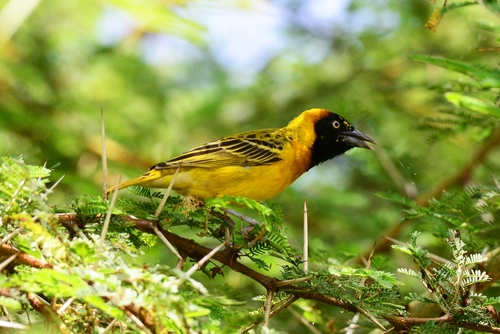
Lesser Masked Weaver
Ploceus intermedius
The Lesser Masked Weaver is the savanna's most industrious architect, known for weaving complex hanging nests and lighting up gardens with its brilliant yellow plumage. A favorite for backyard observers, this social bird brings constant motion and melody to any outdoor space.
Quick Identification
Size
Length: 13–15 cm (5.1–5.9 in); Weight: 16–25 g (0.56–0.88 oz)
Colors
Breeding males feature a bright yellow body with a black facial mask extending to the forecrown. Females and non-breeding males are olive-green and yellow without the mask.
Key Features
- Pale yellowish-white iris
- Black facial mask ending at the mid-crown
- Intricately woven kidney-shaped nest
- Slender black bill
When You’ll See Them
Geographic range
Where Does the Lesser Masked Weaver Live?
Native to the African continent, the Lesser Masked Weaver occupies a massive range across eastern, south-eastern, and southern Africa. Its core populations are found from the Horn of Africa in Ethiopia and Somalia, extending southward through Kenya, Tanzania, and Malawi into the lush suburbs and wild savannas of South Africa, Namibia, and Botswana. While it is widely distributed, it is most common in semi-arid regions that provide access to rivers or permanent water sources, where it can find the flexible grasses needed for nest construction.
Basemap © OpenStreetMap contributors
Behavior
The Lesser Masked Weaver is a highly social and energetic bird, best known for its remarkable architectural skills. These birds are colonial nesters, meaning they live in bustling groups where dozens of males may build their hanging nests in a single tree. You will often see them hanging upside down from branches, fluttering their wings vigorously while singing a series of chattering, swizzling notes to attract a mate. They are frequently found in the company of other weaver species, creating high-traffic avian neighborhoods.
In the backyard setting, they are bold and inquisitive. While they spend much of their time meticulously weaving strips of grass and palm blades into nests, they are also opportunistic foragers. They have developed a comfortable relationship with humans, often visiting garden bird feeders or bird baths. However, their social nature also attracts the Diederik Cuckoo, a brood parasite that frequently tries to sneak its eggs into the weaver's nest, leading to dramatic aerial chases and defensive displays.
EverydayEarth exclusive
Camera Tips
To capture the best footage of the Lesser Masked Weaver, focus your camera on active nesting sites or water features. If you have a thorny tree like an Acacia or a palm tree in your yard, look for the beginning of woven structures. Position your camera about 2-3 meters away from the nest at a slight upward angle. Because these birds are incredibly fast and flutter their wings constantly during displays, use a high shutter speed or a 'sports mode' setting on your AI camera to avoid motion blur.
Bird baths are another high-traffic area. Place your camera at eye level with the rim of the bath, roughly 1 meter away. These weavers love to splash, and the pale iris of the male stands out beautifully against the water. If you are using a trail camera with a PIR sensor, set the sensitivity to 'High' because these small birds move quickly and may not trigger lower sensitivity settings as they zip in and out for a drink.
While they are primarily insect eaters, you can lure them into frame using nectar feeders or fruit halves. They are particularly fond of sweet offerings during the dry season. For the most vibrant colors, ensure your camera is positioned so the morning sun (between 8 AM and 10 AM) hits the bird's feathers directly; this will make the male's yellow plumage pop against the green foliage. In the breeding season, watch for the arrival of the Diederik Cuckoo—if you see a metallic green bird hanging around, keep your camera recording, as a territorial dispute is likely to follow.
Similar Species
Species that look similar or are commonly confused with Lesser Masked Weaver.
Southern Masked Weaver
Larger with a distinctive bright red eye, whereas the Lesser Masked Weaver has a pale whitish-yellow eye.
Village Weaver
Much larger with a mottled back and red eyes; the Lesser Masked Weaver is smaller and more slender.
Spectacled Weaver
Lacks the full black mask, instead having only a black line through the eye like spectacles.
Frequently Asked Questions
Record Lesser Masked Weaver at your habitat
Connect a camera to start building your own species record — AI identifies every visitor automatically.