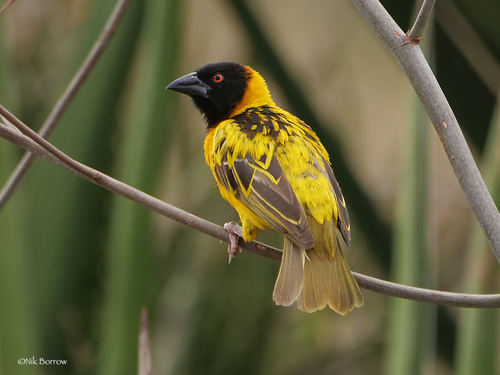
Village Weaver
Ploceus cucullatus
The Village Weaver is nature's master architect, famous for building sprawling hanging colonies and dazzling with its vibrant yellow plumage and red eyes. A common guest in African gardens, this social bird brings a lively energy and a complex soundtrack to any backyard.
Quick Identification
Size
Length 15-17 cm (5.9-6.7 in); Wingspan 24-28 cm (9.4-11 in); Weight 31-45 g (1.1-1.6 oz)
Colors
Breeding males feature a brilliant yellow body, a chestnut-tinted collar, and a distinctive black head. Females and non-breeding males are olive-green above and pale yellow below.
Key Features
- Bright red iris in adults
- Bold black hood and face on breeding males
- Intricate spotted patterns on the back
- Strong, thick conical black bill
When You’ll See Them
Geographic range
Where Does the Village Weaver Live?
The Village Weaver is native to the vast landscapes of sub-Saharan Africa, where it is one of the most common and widely distributed bird species from Senegal to Ethiopia and down to South Africa. Beyond its native range, it has successfully established introduced populations in the Caribbean—most notably on Hispaniola, Puerto Rico, and Martinique—as well as in Venezuela, Mauritius, Réunion, and parts of Portugal. This bird is a true survivor, flourishing wherever there is a mix of open foraging ground and suitable nesting trees near water or human habitation.
Basemap © OpenStreetMap contributors
Behavior
Village Weavers are incredibly social and boisterous birds, living up to their name by forming massive, bustling colonies. They are famous for their remarkable architectural skills, where males compete to weave intricate, kidney-shaped nests using long strips of grass or palm fronds. A single tree can host dozens of these hanging baskets, creating a literal 'village' of avian activity that is often noisy with constant chattering and display songs.
During the breeding season, males perform high-energy displays to attract mates, hanging upside down from their nests while vigorously flapping their wings to show off their handiwork. They are highly intelligent and adaptable, having learned to live alongside humans in gardens and farms. While they are gregarious, they are also quite competitive; it is not uncommon to see a male attempting to steal nesting material from a neighbor's unfinished home when the owner isn't looking.
EverydayEarth exclusive
Camera Tips
To capture the best footage of Village Weavers, position your AI camera near a known nesting tree. These birds are creatures of habit and will return to the same branches repeatedly. Set your camera at a slight upward angle if the nests are low-hanging, or use a tripod-mounted setup at eye-level if you have a clear line of sight to a specific nest entrance. Because they are constantly moving, a fast trigger speed and a high-frame-rate video setting are essential to catch their wing-flapping displays.
In a backyard setting, Village Weavers are easily attracted to bird feeders stocked with mixed seeds, cracked corn, or suet. Position your camera about 4 to 6 feet away from the feeder to get detailed shots of their plumage. If you are using an AI-powered camera, ensure the 'Bird' detection mode is active, as their rapid movements can sometimes be missed by standard motion sensors. Bright, indirect morning light is ideal for highlighting the male's vibrant yellow feathers without blowing out the highlights.
Don't overlook water sources. Village Weavers are frequent bathers and social drinkers. A birdbath placed in a sunny spot with a camera positioned just a few feet away will provide excellent action shots of 'splashing' behavior. Since they often visit in groups, use a wider field of view for your camera to capture the social dynamics of the flock rather than just a single bird. During the peak of the weaving season, you can also place short lengths of dried grass or palm strips near your camera to record them 'gathering' supplies for their nests.
Similar Species
Species that look similar or are commonly confused with Village Weaver.
Lesser Masked Weaver
Smaller in size with a less extensive black mask that doesn't cover the entire head, and a plain rather than mottled back.
Speke's Weaver
Lacks the full black hood of the Village Weaver, showing only a black face mask and throat.
Southern Masked Weaver
Features a smaller black mask that ends on the forehead and lacks the dark spotting on the mantle seen in the Village Weaver.
Frequently Asked Questions
Record Village Weaver at your habitat
Connect a camera to start building your own species record — AI identifies every visitor automatically.