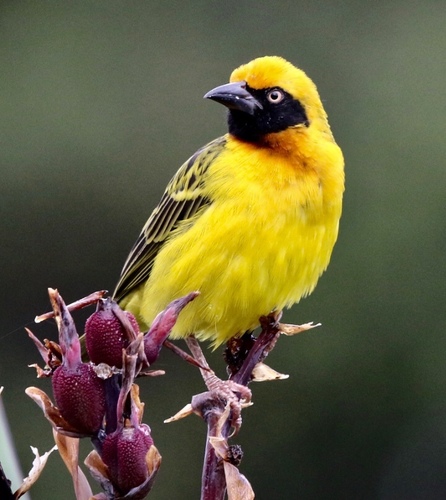
Speke's Weaver
Ploceus spekei
The Speke's Weaver is a vibrant, golden-hued architect of the East African savanna, famous for its elaborate woven nests and boisterous social colonies.
Quick Identification
Size
15 cm (6 inches) in length; weighs approximately 34-42 g (1.2-1.5 oz)
Colors
Breeding males have bright yellow heads and underparts with a distinct black face mask; females and juveniles are duller with olive-streaked backs and pale yellow-buff underparts.
Key Features
- Distinct black mask and throat on males
- Pale yellowish-white iris
- Conical, heavy bill for seed-cracking
- Bright golden-yellow plumage in breeding season
When You’ll See Them
Geographic range
Where Does the Speke's Weaver Live?
Native to the African continent, Speke's Weaver is a signature species of the East African highlands and interior plateaus. Its core range is concentrated in the Horn of Africa and the Great Rift Valley, stretching from central Ethiopia and Somalia down through the heart of Kenya into northern Tanzania. These birds are particularly well-established in urban areas like Nairobi and Addis Ababa, where they thrive in public parks and residential backyards.
Basemap © OpenStreetMap contributors
Behavior
Speke's Weavers are exceptionally social and boisterous birds, often living in large, noisy colonies that can dominate a single tree. They are famous for their engineering skills; males spend much of their time weaving intricate, oval-shaped nests from strips of grass and palm fronds. These nests are suspended from branches, often in acacia trees, creating a bustling apartment-complex effect that serves as the center of their social life.
In human-dominated landscapes, these birds are bold and adaptable. They are frequently seen in suburban gardens, where they compete vigorously at bird feeders and bird baths. Their vocalizations are a constant chatter of wheezing, chirping, and buzzing notes, especially during the breeding season when males display with fluttering wings to attract females to their handiwork. They are highly communal, foraging in groups and often joining mixed-species flocks with starlings and other weavers.
EverydayEarth exclusive
Camera Tips
To capture high-quality footage of Speke's Weavers, focus your camera efforts on water features and feeding stations. In the dry East African climate, a garden bird bath is a magnet for these social birds. Place your camera approximately 3 to 5 feet from the water at a low angle to catch the action of their vigorous splashing. Since they often visit in groups, set your camera to 'Video' or 'Burst' mode to capture the social dynamics and the characteristic fluttering of their bright yellow wings.
For backyard feeders, Speke's Weavers are most attracted to platforms or hanging feeders filled with small seeds like millet or sunflower hearts. Mount your camera at a height of about 4 to 5 feet, roughly level with the feeder, to get clear eye-level shots. Because they are fast-moving, a camera with a quick trigger speed (0.3 seconds or less) is ideal to avoid capturing just a tail-feather as they fly off. Ensure the camera is positioned to take advantage of the morning sun, which highlights the vivid contrast of the male's black mask against his golden head.
During the breeding season, you can achieve spectacular results by aiming your camera toward a nesting colony in an acacia or similar tree. If you have a clear line of sight from a balcony or a tall tripod, you can record the males as they perform their 'pendulum' displays—swinging below their nests while calling. Avoid placing the camera too close to the nests to prevent disturbing the birds; instead, use a camera with a decent optical zoom or high resolution that allows for cropping in post-production without losing detail.
Similar Species
Species that look similar or are commonly confused with Speke's Weaver.
Village Weaver
The Village Weaver has a bright red eye and a more extensive black hood that often covers the entire head, whereas Speke's has a pale eye and a limited black mask.
Baglafecht Weaver
Baglafecht Weavers have a distinct yellow patch behind the eye and lack the overall bright golden-yellow underparts of the Speke's Weaver.
Lesser Masked Weaver
Smaller in size with a much more restricted black mask that does not extend as far down the throat, and it also features a white or pale eye.
Frequently Asked Questions
Record Speke's Weaver at your habitat
Connect a camera to start building your own species record — AI identifies every visitor automatically.