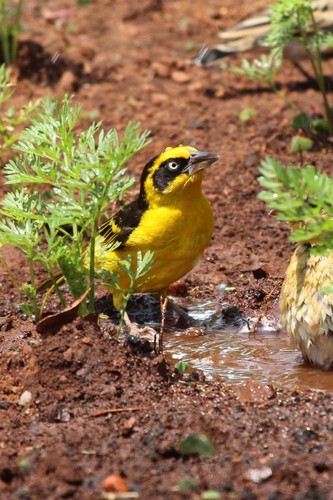
Baglafecht Weaver
Ploceus baglafecht
A dapper highland resident, the Baglafecht Weaver is famous for its striking pale eyes and masterfully woven nests. A frequent visitor to African gardens, this bold bird brings vibrant color and cheerful song to higher elevations.
Quick Identification
Size
14-16 cm (5.5-6.3 in) in length; weighs approximately 25-37g (0.9-1.3 oz)
Colors
Bright yellow underparts and forehead, olive-green back, black mask around the eyes, and a distinctive pale yellowish-white iris.
Key Features
- Distinctive pale whitish-yellow iris
- Black mask extending from the bill through and behind the eye
- Yellow forehead and underparts
- Olive-green mantle and wings with darker streaking
When You’ll See Them
Geographic range
Where Does the Baglafecht Weaver Live?
The Baglafecht Weaver is a signature species of the African highlands, native to the mountainous regions of Eastern and Central Africa. Its primary range encompasses the elevated landscapes of Ethiopia, Kenya, Uganda, and Tanzania, where it thrives in the cooler, moister air. Disjunct populations can also be found in the high-altitude forests of the Democratic Republic of the Congo, Nigeria, and Cameroon, making it a widespread but elevation-specific resident of the continent.
Basemap © OpenStreetMap contributors
Behavior
Baglafecht Weavers are energetic and highly social birds, though they are notably less colonial than many of their weaver relatives. Instead of forming massive, noisy colonies, they are more frequently seen in pairs or small family groups. They are active foragers, often seen acrobatically clinging to flower heads or hopping through garden shrubbery in search of insects and seeds. Their song is a cheerful, complex series of whistles and chatters, and they are known to be skilled mimics, often incorporating the calls of other birds into their own melodies.
In suburban environments, these birds are remarkably bold and adaptable. They are famous for their intricate nest-building skills; males weave oval-shaped nests using thin strips of grass or palm fronds. These nests are typically suspended from the tips of branches, often overhanging water or clearings for protection. Unlike some weaver species that abandon their nests after one season, Baglafecht Weavers may remain in the same territory year-round if the food supply is stable.
EverydayEarth exclusive
Camera Tips
To capture the best footage of a Baglafecht Weaver, focus your camera on elevated perches or near nectar-rich plants like Aloes, Grevilleas, or Red Hot Pokers. These birds are frequent garden visitors, so mounting your camera on a fence post or a specialized bird-feeder pole at a height of 1.5 to 2 meters (5-6 feet) is ideal. They are quick and twitchy, so ensure your camera is set to a high trigger speed to catch them before they flutter away.
Providing a platform feeder with a mix of sunflower hearts and crushed grains is a great way to encourage them to stay still for the lens. Because they are often found in pairs, try using a wider-angle lens setting if your camera allows, which increases the chance of capturing social interactions or a pair feeding together. If you are looking for action shots, place the camera near the ends of flexible branches where they might begin weaving their distinctive nests during the rainy seasons.
Lighting is crucial for this species because their bright yellow feathers can easily overexpose in direct, harsh sunlight, washing out the detail. Position your camera so the sun is behind it during the early morning or late afternoon. This 'golden hour' light beautifully highlights their unique pale irises and the subtle olive-green textures of their wings. If your AI camera has a 'pet' or 'bird' detection mode, ensure it is active to prioritize focus on the bird's eye.
Similar Species
Species that look similar or are commonly confused with Baglafecht Weaver.
Holub's Golden Weaver
Larger overall with a heavier bill and lacks the distinct black facial mask of the Baglafecht.
Spectacled Weaver
Has a much thinner black line through the eye and more uniform orange-yellow plumage on the head.
Black-headed Weaver
Features a full black hood covering the entire head, rather than just a mask around the eyes.
Frequently Asked Questions
Record Baglafecht Weaver at your habitat
Connect a camera to start building your own species record — AI identifies every visitor automatically.