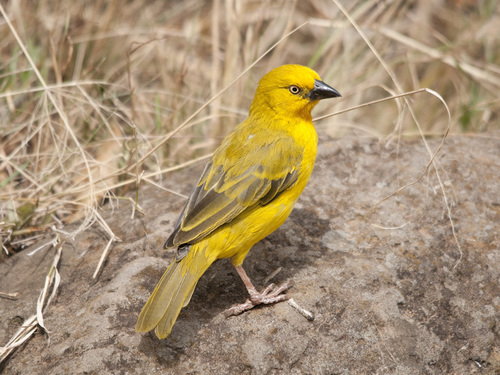
Holub's Golden-Weaver
Ploceus xanthops
A radiant resident of African wetlands and gardens, Holub's Golden-Weaver stands out with its sun-drenched plumage and striking pale eyes. This master architect skips the typical black mask of other weavers, offering a pure, golden spectacle.
Quick Identification
Size
Length: 17–19 cm (6.7–7.5 in); Weight: 35–50 g (1.2–1.8 oz)
Colors
Brilliant golden-yellow body; males have an orange-buff wash on the throat and face; females are slightly duller with a greenish-yellow tint; pale yellowish-white eyes
Key Features
- Golden-yellow plumage without a black face mask
- Pale whitish or light yellow eyes
- Heavy, conical black bill
- Large, robust build compared to other weavers
- Greenish-yellow wings with paler feather edges
When You’ll See Them
Geographic range
Where Does the Holub's Golden-Weaver Live?
This vibrant bird is native to the African continent, spanning a wide territory across Sub-Saharan Africa. Its core range begins in the west from Gabon and extends through Central Africa into the lake regions of Uganda and Kenya, eventually reaching southward through Tanzania, Zambia, and Malawi. It is also commonly found in northern Namibia, northern Botswana, and throughout the eastern provinces of South Africa, particularly in areas where water and lush vegetation are abundant.
Basemap © OpenStreetMap contributors
Behavior
Holub's Golden-Weavers are charismatic and energetic birds that bring a splash of sunshine to any backyard. Unlike many of their cousins, they are less likely to nest in massive, noisy colonies, preferring instead to live in pairs or small, loose groups. They are highly active foragers, often seen hopping through the canopy or clinging to reed stalks in search of food. Their social nature makes them a joy to watch, especially when they gather at communal water sources.
These weavers are famous for their engineering skills. Males spend a significant portion of the breeding season meticulously weaving kidney-shaped nests from long, thin strips of grass or palm fronds. These nests are usually suspended from the tips of branches overhanging water, a clever tactic to deter predators. They are also quite vocal, possessing a complex repertoire of swizzling songs and sharp contact calls that can be heard throughout the day.
EverydayEarth exclusive
Camera Tips
To capture the best footage of Holub's Golden-Weaver, position your AI camera near a shallow water feature or bird bath. These birds are avid bathers and will frequently visit to splash and preen, especially during the warmer midday hours. Setting the camera at a low angle, roughly 1 to 2 feet above the water level, provides an intimate perspective that highlights their unique pale eyes and bright plumage.
If you are using a feeder to attract them, mount the camera about 4 to 6 feet high. They are particularly fond of suet, fresh fruit like halved oranges or apples, and sunflower hearts. Because they are fast-moving, use a high-speed trigger setting or video mode to ensure you don't just catch a blur of yellow. Placing the camera in a spot that receives soft morning light will bring out the golden highlights of their feathers without the harsh shadows of the midday sun.
During the breeding season (September to March), look for males stripping grass nearby. If you can locate a nest under construction, place your camera on a tripod at a respectful distance of at least 15 feet. This is the best way to capture the incredible 'weaving' behavior. Avoid placing cameras directly next to the nest to ensure the birds do not feel threatened. A 4K video setting is highly recommended here to capture the intricate detail of the grass-work.
Similar Species
Species that look similar or are commonly confused with Holub's Golden-Weaver.
Village Weaver
The Village Weaver has a prominent black head mask and striking red eyes, whereas Holub's is entirely golden-faced with pale eyes.
Spectacled Weaver
Has a much thinner bill and a very distinct black line running through the eye, resembling spectacles.
Cape Weaver
Larger in size with a much longer, more pointed bill and a darker orange wash across the face.
Frequently Asked Questions
Record Holub's Golden-Weaver at your habitat
Connect a camera to start building your own species record — AI identifies every visitor automatically.