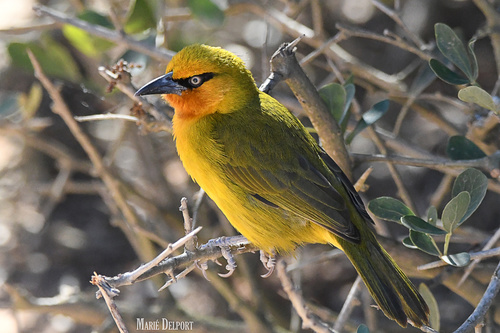
Spectacled Weaver
Ploceus ocularis
With its distinctive black 'spectacles' and piercing pale eyes, the Spectacled Weaver is a master architect of the African garden. Unlike its colonial cousins, this bird lives a quiet, solitary life, weaving intricate, hanging nests that are true marvels of natural engineering.
Quick Identification
Size
Length: 15–17 cm (6–6.7 in); Weight: 22–40 g (0.8–1.4 oz)
Colors
Bright yellow plumage with an olive-green back and wings. Both sexes feature a sharp black line through the eye and pale cream-colored eyes. Males have a black throat patch.
Key Features
- Narrow black 'spectacle' line through the eye
- Strikingly pale, almost white iris
- Solitary, retort-shaped nest with a long entrance tunnel
- Bright yellow underparts and olive-yellow mantle
When You’ll See Them
Geographic range
Where Does the Spectacled Weaver Live?
The Spectacled Weaver is a permanent resident throughout much of Sub-Saharan Africa, favoring moist, wooded environments over arid plains. Its range extends from the coastal forests of South Africa and Mozambique, through the Great Lakes region of East Africa, and westward into the humid savannas of Cameroon and Nigeria. While they avoid the deep, lightless interior of primary rainforests and the driest deserts, they are incredibly successful in 'edge' habitats, making them a staple species in leafy suburbs across the continent.
Basemap © OpenStreetMap contributors
Behavior
The Spectacled Weaver is a delightful departure from many of its more boisterous relatives. While many weaver species are highly social and nest in noisy colonies, the Spectacled Weaver is a dedicated introvert, usually found in solitary pairs. They are quiet, methodical foragers, often seen creeping along branches or hanging upside down to glean insects from the undersides of leaves with their sharp, pointed bills. Their presence is often announced by a characteristic song: a series of clear, descending whistles that sound remarkably like a human whistling a jaunty tune.
In suburban environments, they are bold and inquisitive, frequently investigating porches or windows for spiderwebs. They are master architects, known for weaving some of the most intricate nests in the bird world. These thin-walled, 'sock-like' structures feature a long downward-pointing entrance tunnel, sometimes reaching over 20 centimeters in length, designed specifically to thwart tree snakes and other nest predators. Because they stay with their mates year-round, you will often see the same pair patrolling a garden territory for several seasons.
EverydayEarth exclusive
Camera Tips
To capture high-quality footage of the Spectacled Weaver, focus your camera efforts on water and nesting sites. These birds are frequent visitors to birdbaths, but they prefer shallow, moving water. Position your camera at eye level with the water source, approximately 1 to 1.5 meters away. Using a tripod-mounted setup with a fast shutter speed is essential, as their movements while bathing are incredibly rapid and prone to motion blur.
If you are lucky enough to have a pair nesting in your yard, do not mount the camera directly onto the nest branch, as this may cause the birds to abandon the site. Instead, mount the camera on a nearby stable structure or a separate pole about 2 meters away, angled to face the side of the nest entrance. Because their nests have long entrance 'sleeves,' a side profile shot captures the spectacular sight of the bird flying vertically upward into the tunnel. Use a 'Burst Mode' or high-frame-rate video setting (60fps or higher) to see the detail in their wing movements during entry.
For food-based attractants, Spectacled Weavers are less likely to visit traditional seed feeders than other weavers. However, they are highly attracted to suet and nectar feeders. If you use an AI-powered camera with a feeder attachment, fill it with high-protein suet or a sugar-water solution. They are most active in the early morning light; however, because of their bright yellow feathers, direct midday sun can overexpose the image. Setting your camera's exposure compensation to -0.3 or -0.7 can help preserve the rich detail in their yellow plumage during the brightest hours of the day.
Similar Species
Species that look similar or are commonly confused with Spectacled Weaver.
Village Weaver
Much larger and noisier; males have a full black hood and red eyes, rather than just a thin eye-stripe and pale eyes.
Holub's Golden Weaver
Lacks the black eye-stripe entirely and has a thicker, heavier bill.
Lesser Masked Weaver
Has a full black face mask and a white eye, but is smaller and much more social, nesting in colonies.
Frequently Asked Questions
Record Spectacled Weaver at your habitat
Connect a camera to start building your own species record — AI identifies every visitor automatically.