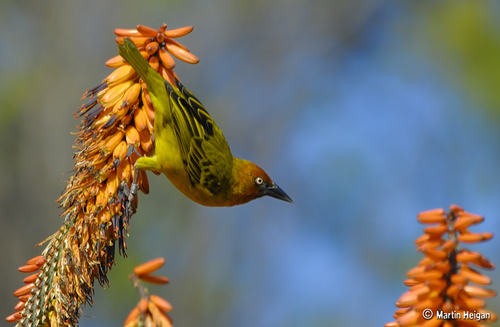
Cape Weaver
Ploceus capensis
Meet the master architect of the South African backyard. With its brilliant yellow plumage and incredible nest-building skills, the Cape Weaver is a vibrant highlight for any nature camera enthusiast.
Quick Identification
Size
Length: 17–18 cm (6.7–7.1 in); Weight: 40–52 g (1.4–1.8 oz)
Colors
Males are bright yellow with a distinct orange-brown wash on the face and a pale cream eye; females and juveniles are olive-yellow with dark brown eyes.
Key Features
- Bright yellow plumage with orange facial wash (breeding male)
- Distinctive pale cream-colored iris in adult males
- Large, heavy conical bill
- Intricate kidney-shaped nests woven from grass
When You’ll See Them
Geographic range
Where Does the Cape Weaver Live?
The Cape Weaver is an African endemic, found exclusively in the southern regions of the continent. Its core range spans across the majority of South Africa, from the coastal fynbos of the Western Cape through the Eastern Cape and into the highveld of the interior. It is also commonly found throughout Lesotho and parts of Eswatini. While it is a staple of wild riverine thickets, it has successfully transitioned into human-altered landscapes, making it one of the most frequently recorded birds in South African suburban gardens.
Basemap © OpenStreetMap contributors
Behavior
Cape Weavers are highly social and energetic birds, best known for their incredible architectural skills. They are colonial nesters, with males often constructing multiple elaborate, kidney-shaped nests hanging from tree branches or reeds to attract mates. You will often hear them before you see them, as their colonies are filled with a noisy, chattering cacophony of 'swizzling' calls and vigorous wing-flapping displays used to advertise their nests to passing females.
In suburban settings, they are bold and highly adaptable. They frequent garden bird feeders and are often seen hanging upside down from flowers or feeders with surprising agility. They are cooperative yet competitive; males will fiercely defend their small nesting territories within a single tree, while females act as the ultimate judges of craftsmanship, sometimes tearing apart a poorly made nest to force the male to start over from scratch.
EverydayEarth exclusive
Camera Tips
To capture the best footage of Cape Weavers, focus your camera on water sources or nectar-rich plants. A bird bath is an excellent magnet for these birds, as they are frequent drinkers and enthusiastic bathers. Position your AI-powered camera about 1.5 to 2 meters (5-6 feet) away from the water at eye level to get crisp, clear portraits. Since these birds are fast-moving and twitchy, ensure your camera has a high shutter speed or 'action' mode enabled to avoid motion blur during their frequent wing-flapping displays.
If you have Aloes or Proteas in your garden, these are prime spots for Weaver activity. Place your camera on a tripod or mount it to a nearby post facing the blooms. Cape Weavers have a unique way of hanging upside down to reach nectar, which makes for spectacular, acrobatic photos. If using a feeder, suet blocks or fruit like halved oranges are highly effective lures that will keep them stationary long enough for your camera to trigger and focus properly.
During the breeding season (typically August to February), look for their nests. If you have a colony in a tree, position your camera with a wide view of the nest entrances. However, be careful not to place the camera too close to the nest itself to avoid disturbing the birds. A zoom lens or a higher mounting position on a fence or wall can provide a great 'bird’s eye view' of the males' frantic building activities and the social drama of the colony.
Lighting is crucial for bringing out the Cape Weaver's brilliant yellow. Morning light—the golden hour—is best for highlighting the orange wash on the male's face and his distinctive pale eye. Avoid shooting directly into the sun; instead, position your camera so the sun is behind it, illuminating the bird's front. This will also help your AI camera correctly identify the species by emphasizing its specific color patterns and iris color.
Similar Species
Species that look similar or are commonly confused with Cape Weaver.
Southern Masked Weaver
The Southern Masked Weaver is smaller and features a prominent black face mask and bright red eyes, unlike the Cape Weaver's orange face and pale eyes.
Village Weaver
Village Weavers have a heavily mottled black-and-yellow back and red eyes, whereas Cape Weavers have a more uniform olive-yellow back.
Frequently Asked Questions
Record Cape Weaver at your habitat
Connect a camera to start building your own species record — AI identifies every visitor automatically.