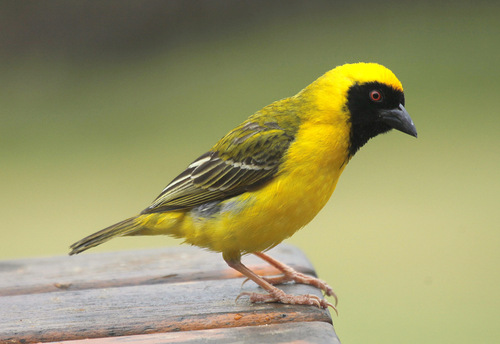
Southern Masked Weaver
Ploceus velatus
Meet the master architect of the African suburbs. Famous for their brilliant yellow plumage and incredible nest-weaving skills, Southern Masked Weavers are energetic neighbors that bring life to any backyard camera.
Quick Identification
Size
Length 11–15 cm (4.3–5.9 in); weight 20–35 g (0.7–1.2 oz)
Colors
Breeding males feature a striking black face mask, red eyes, and bright yellow plumage. Females and non-breeding males are olive-green to yellow with horn-colored bills and brown eyes.
Key Features
- Black facial mask extending to a point on the throat
- Bright red iris in breeding males
- Conical black bill
- Intricately woven kidney-shaped nests hanging from branches
When You’ll See Them
Geographic range
Where Does the Southern Masked Weaver Live?
The Southern Masked Weaver is native to the southern half of the African continent. Its core range covers almost the entirety of South Africa, Namibia, Botswana, Zimbabwe, and Mozambique, while also extending north into southern Angola, Zambia, and Malawi. It is one of the most widely distributed and successful bird species in the region, adapting effortlessly to human-altered landscapes and arid environments alike.
Basemap © OpenStreetMap contributors
Behavior
The Southern Masked Weaver is most famous for its architectural prowess. Males are tireless builders, weaving complex, kidney-shaped nests from strips of grass, reeds, or palm fronds. This behavior is a critical part of courtship; a single male may build up to 25 nests in one season, hoping to entice a female with his craftsmanship. They are highly social birds, often nesting in noisy, bustling colonies within the same tree, frequently choosing branches overhanging water for added protection from snakes and other predators.
In the backyard, they are bold, energetic, and highly vocal. They are common visitors to bird feeders and are known for their high-pitched, swizzling songs. While they can be somewhat territorial around their immediate nesting sites, they generally interact well with other bird species at neutral feeding and watering areas. During the breeding season, males are exceptionally active, hanging upside down from their half-finished nests while vigorously flapping their wings and chirping to attract passing females.
EverydayEarth exclusive
Camera Tips
To capture the Southern Masked Weaver on camera, focus on two key areas: the bird feeder and the nest site. During the breeding season (typically September to January), identify a tree where males are actively weaving. Position your camera on a tripod or mount it to a nearby branch at a height of 5 to 8 feet, angling it slightly upward toward the entrance of the hanging nest. Using a high-frame-rate video setting is essential to catch the rapid, characteristic wing-flapping displays males perform to attract mates.
If you are using a backyard AI camera or a trail cam near a feeding station, use a mix of wild bird seed, crushed maize, or sunflower seeds. These weavers are particularly fond of high-energy foods and will visit a feeder dozens of times a day. Placing a bird bath within the camera's field of view is another excellent strategy; they are frequent bathers, and the splashing action makes for dynamic and engaging footage. Ensure the camera is positioned to catch the morning sun, as the direct light really makes the male's yellow plumage and red eyes pop.
Because these birds move with incredible speed and can be quite 'twitchy,' set your PIR sensor to high sensitivity and minimize the trigger delay. If your camera supports it, a 'burst mode' for photos will help you capture that perfect shot of a weaver mid-flight or while it is hanging upside down from a nest. During the winter months, they lose their bright breeding plumage and look much like the females, so keep the camera active year-round to document their fascinating seasonal transformation.
Similar Species
Species that look similar or are commonly confused with Southern Masked Weaver.
Village Weaver
Larger with a spotted/mottled back and a different facial mask shape compared to the Southern Masked Weaver's plain back.
Lesser Masked Weaver
Smaller with a pale whitish-yellow eye and a mask that extends further back over the forehead.
Cape Weaver
Lacks the black facial mask entirely and has a much longer, more pointed bill and a pale iris.
Frequently Asked Questions
Record Southern Masked Weaver at your habitat
Connect a camera to start building your own species record — AI identifies every visitor automatically.