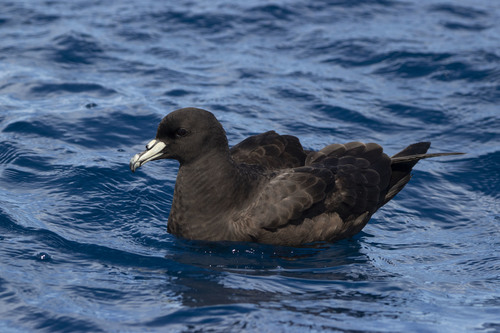
Black Petrel
Procellaria parkinsoni
A master of the open ocean, the Black Petrel travels from New Zealand to South America before returning to nest in the roots of ancient island forests. This rare, nocturnal voyager is a testament to the incredible endurance of pelagic life.
Quick Identification
Size
Length of 46 cm (18 in), wingspan of 115 cm (45 in), and weight of 680-720 g (1.5-1.6 lbs)
Colors
Uniformly soot-black or dark brownish-black plumage; bill is pale yellowish-ivory with a distinct dark tip; legs and feet are black
Key Features
- Uniformly soot-black plumage
- Pale yellow bill with a dark-colored tip
- Tube-shaped nostrils on the upper mandible
- Medium build with long, pointed wings
When You’ll See Them
Geographic range
Where Does the Black Petrel Live?
This elusive seabird is a native of the Southwest Pacific, breeding exclusively on Great Barrier and Little Barrier Islands off the North Island of New Zealand. During the non-breeding months, they undertake a massive migration across the Pacific Ocean, reaching the coastal waters of Australia to the west and the tropical waters of Ecuador, Peru, and Chile to the east. They are most commonly found in deep oceanic waters, far from the continental shelf, except when returning to their specific New Zealand island nurseries.
Basemap © OpenStreetMap contributors
Behavior
The Black Petrel, also known as Parkinson's Petrel, is a highly pelagic seabird that spends the majority of its life over the open ocean. They are legendary navigators, capable of flying thousands of miles across the Pacific. During the breeding season, they return to New Zealand to nest in colonies. They are strictly nocturnal on land, arriving at their burrows under the cover of darkness to avoid predation by skuas and gulls. Their arrival is often signaled by a chorus of loud, clattering, and groaning calls that echo through the forest.
At sea, these petrels are opportunistic and skilled foragers. They are particularly well-known for their diving ability, often plunging several meters below the surface to pursue squid and fish. They are social birds when feeding and are frequently seen following fishing vessels to scavenge discarded offal. Despite their social nature at sea, they are fiercely territorial over their underground burrows, which they excavate in the soft soil among the roots of large trees.
EverydayEarth exclusive
Camera Tips
Capturing the Black Petrel on camera requires specific targeting of their breeding grounds on Great Barrier or Little Barrier Island, as they are almost never seen on land elsewhere. Because they are strictly nocturnal when visiting their nests, a camera with high-quality infrared (No-Glow) capabilities is mandatory. Standard white flashes will startle the birds and may interfere with their ability to navigate the dense forest canopy. Set your camera near the entrance of known burrows, typically found at the base of large trees or under dense ferns on steep slopes.
Position the camera low to the ground, about 30 centimeters (1 foot) up, and angle it slightly downward. Black Petrels are clumsy on land and move with a shuffling gait, so they are relatively easy to capture if you find their well-trodden 'runways'—the paths they take through the leaf litter from their landing spots to their burrows. Use a fast trigger speed, as they can scurry surprisingly quickly when heading for cover. High-sensitivity motion sensors are best for detecting their movement in the low-contrast environment of the forest floor at night.
For the most engaging results, set your camera to record short video clips (15-30 seconds). This allows you to capture not just their appearance, but their unique terrestrial behavior and the strange, mechanical-sounding vocalizations they use to communicate with mates. Look for signs of activity such as freshly dug soil or the smell of musky oil near burrow entrances. Always ensure that your camera setup does not obstruct the entrance to the burrow or disturb the surrounding vegetation, as these birds are highly sensitive to habitat changes.
Similar Species
Species that look similar or are commonly confused with Black Petrel.
Flesh-footed Shearwater
The Flesh-footed Shearwater has pinkish-flesh colored legs and feet, whereas the Black Petrel has entirely black legs.
Westland Petrel
The Westland Petrel is significantly larger and heavier, and it breeds only in the South Island of New Zealand.
White-chinned Petrel
Larger than the Black Petrel, the White-chinned Petrel usually has a small patch of white feathers under the chin and a completely pale bill tip.
Frequently Asked Questions
Record Black Petrel at your habitat
Connect a camera to start building your own species record — AI identifies every visitor automatically.