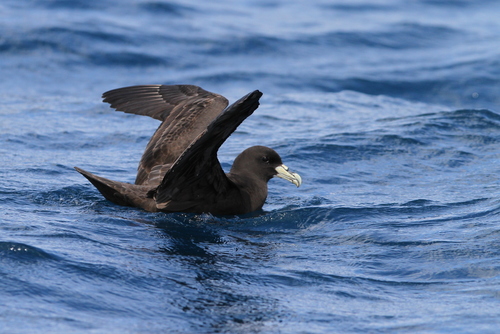
White-chinned Petrel
Procellaria aequinoctialis
Often called the 'Shoemaker' for its rhythmic calls, the White-chinned Petrel is a dark-cloaked giant of the Southern Ocean. This resilient seabird spends its life navigating the world's most turbulent waves, returning to land only under the cover of night.
Quick Identification
Size
Length: 51–58 cm (20–23 in); Wingspan: 134–147 cm (53–58 in); Weight: 1–1.5 kg (2.2–3.3 lbs)
Colors
Uniformly sooty-black plumage with a small, variable white patch on the chin; bill is pale yellow or cream-colored with a blackish tip.
Key Features
- Large, heavy-set blackish body
- Distinctive pale yellow bill with dark tip
- Variable white feathering under the chin
- Long, broad wings used for effortless gliding
When You’ll See Them
Behavior
The White-chinned Petrel is a master of the Southern Ocean, known to sailors as the 'Shoemaker' due to the rhythmic clacking sounds it makes from its burrow. These birds are highly pelagic, meaning they spend the vast majority of their lives at sea, only returning to land to breed on remote, sub-antarctic islands. They are social birds when foraging, often seen in large groups following fishing vessels or congregating where cold and warm ocean currents meet.
On land, they are strictly nocturnal to avoid the predatory gaze of gulls and skuas. They nest in deep, muddy burrows which they defend vigorously. While they can appear clumsy on land, they are incredibly graceful in flight, using a combination of flapping and soaring to cover thousands of miles in search of food. Their interaction with humans is primarily limited to their presence around fishing boats, where they are unfortunately prone to accidental capture in longline fisheries.
EverydayEarth exclusive
Camera Tips
Capturing a White-chinned Petrel on camera is a challenge reserved for those living in or visiting specialized coastal or island environments. Because these birds only come ashore at night to access their burrows, your camera must have high-quality Infrared (IR) night vision capabilities. Place your camera on a low tripod or a short stake, positioned roughly 12-18 inches off the ground, facing a known burrow entrance. Since the birds are dark-feathered, increase your camera’s exposure compensation slightly to capture detail against the dark soil.
Avoid using white-flash cameras, as the sudden burst of light can disorient the birds or lead them toward predators. Instead, stick to 'No-Glow' or 'Black IR' LEDs. If you are setting up near a colony, the most activity occurs just after dusk and just before dawn as parents rotate incubation or feeding duties. Set your camera to 'Video' mode with a duration of at least 20 seconds; the unique 'shoemaking' vocalizations and the mechanical clattering of their bills are just as important as the visual evidence.
For those monitoring coastal areas from afar, high-speed shutter settings are required for daytime shots to freeze the bird's rapid movement over the waves. If you are trying to capture them from a vessel or a cliffside, use a camera with a fast AI-tracking autofocus. Because they are attracted to fish oil, some researchers use a 'scent lure' (like a sponge soaked in fish oil) placed within view of a trail cam to encourage the bird to land or linger in a specific frame, though this should be done with caution to avoid interfering with natural behavior.
Similar Species
Species that look similar or are commonly confused with White-chinned Petrel.
Spectacled Petrel
Almost identical in size, but possesses distinct white 'spectacle' markings around the eyes.
Westland Petrel
Slightly smaller with a darker tip on the bill; primarily breeds on the South Island of New Zealand.
Northern Giant Petrel
Much larger with a massive, bulbous bill and a more mottled, grayish-brown appearance.
Frequently Asked Questions
Record White-chinned Petrel at your habitat
Connect a camera to start building your own species record — AI identifies every visitor automatically.