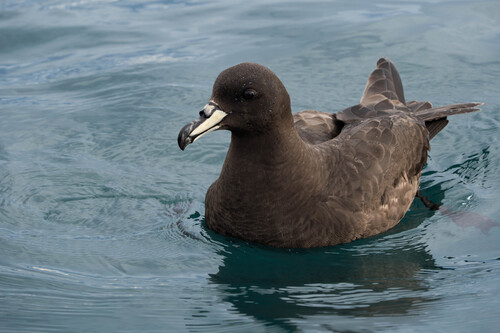
Westland Petrel
Procellaria westlandica
The Westland Petrel is the mysterious 'ghost of the forest,' a seafaring giant that travels thousands of miles across the Pacific only to return to a hidden burrow beneath the New Zealand rainforest.
Quick Identification
Size
Length: 50-55 cm (20-22 in); Wingspan: 135-140 cm (53-55 in); Weight: 1,100 g (2.4 lbs)
Colors
Uniformly dark blackish-brown plumage; pale ivory or yellow bill with a distinct black tip; black legs and feet.
Key Features
- Stocky, heavy-set body
- Pale yellow bill with a prominent black tip
- Uniformly dark chocolate-brown to black feathers
- Large burrows located on forested hillsides
When You’ll See Them
Behavior
The Westland Petrel is a remarkable seabird that balances a life on the high seas with a unique breeding cycle in the temperate rainforests of New Zealand. Unlike many other petrels, they are winter breeders, returning to their colonies when many other species have departed. They are highly social and vocal, particularly at night when the forest canopy echoes with their guttural croaks, cackles, and shrieks as they greet mates and defend their burrows.
On land, these birds can appear somewhat clumsy. They arrive at their colonies just after dusk, often crash-landing through the forest canopy before scuttling across the leaf litter to reach their underground homes. They are master navigators at sea, often following fishing vessels for hundreds of miles to scavenge for scraps, showing a bold and opportunistic side to their personality that contrasts with their cautious behavior at the nesting site.
EverydayEarth exclusive
Camera Tips
Capturing the Westland Petrel on camera is a thrilling challenge because they are strictly nocturnal on land and inhabit very specific, rugged terrain. If you are monitoring a known colony area, the most effective placement is roughly 12 to 18 inches off the ground. Angle the camera slightly downward toward a burrow entrance or a clear 'runway' in the forest floor where birds are likely to walk. Because they are heavy birds that land with a distinct 'thud' before walking, a wide-angle lens is ideal for capturing them as they emerge from the shadows of the ferns.
Lighting is the most critical factor. Westland Petrels are highly susceptible to 'sky-strike' or disorientation caused by artificial white light. It is essential to use a camera equipped with 'No-Glow' or 'Black' Infrared (IR) LEDs. This ensures the birds aren't startled or blinded as they navigate the dark forest floor. Set your camera to take short video clips (10-15 seconds) rather than just stills; the way these birds scuttle and interact with their environment is a key part of their charm and much easier to identify in motion.
Timing is everything for this species. Ensure your camera is active from late March through December, with the highest frequency of movement occurring during the chick-rearing months of late winter and spring. Avoid using any form of bait or food lure; these birds are strictly pelagic feeders and won't be attracted to standard bird food. Instead, look for 'launch trees'—sloping trunks or rocks where the birds climb to get enough elevation to take flight at dawn—and position your camera to catch their morning departure.
Similar Species
Species that look similar or are commonly confused with Westland Petrel.
Frequently Asked Questions
Record Westland Petrel at your habitat
Connect a camera to start building your own species record — AI identifies every visitor automatically.