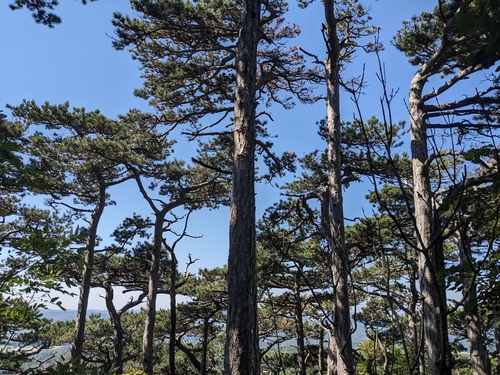
black pine
Pinus nigra
Rugged, resilient, and reaching for the clouds, the black pine is an evergreen icon that provides vital shelter for owls and woodpeckers in backyards and wild forests alike.
Quick Identification
Size
Height of 20-55 metres (66-180 feet); trunk diameter up to 2 metres (6.5 feet)
Colors
Dark green to yellowish-green needles; grey-brown to blackish plate-like bark; yellowish-brown cones
Key Features
- Long needles in pairs, 8-16 cm (3-6 inches) long
- Bark is deeply fissured into irregular grey-black plates
- Egg-shaped cones with rounded scales
- Dense, conical crown that flattens with age
When You’ll See Them
Geographic range
Where Does the black pine Live?
Native to the Mediterranean basin and Southern Europe, the black pine flourishes from the Iberian Peninsula and North Africa through Italy and the Balkans into Turkey. Its heartland includes the high mountains of the Mediterranean islands like Corsica and Cyprus, as well as the rugged terrains of the Anatolian peninsula. Because of its legendary toughness, it has been widely introduced and successfully naturalized across the United Kingdom, northern Europe, and much of the United States and Canada, where it is a staple of coastal and urban landscaping.
Basemap © OpenStreetMap contributors
Behavior
In the wild, this tree plays a vital role in its ecosystem by providing year-round thermal cover for large birds and mammals. During the winter, its dense foliage acts as a windbreak, creating a microclimate beneath its branches where smaller animals can seek refuge. It also forms complex symbiotic relationships with various soil fungi, which help it extract nutrients from poor, limestone-based soils where other trees might struggle.
EverydayEarth exclusive
Camera Tips
When using an AI-powered camera to monitor a black pine, the tree itself acts as a massive 'wildlife hub.' To capture the greatest variety of visitors, place your camera at a mid-trunk height of 5-8 feet, angled slightly upward. This allows you to catch climbing specialists like Nuthatches and Woodpeckers who search the deep fissures of the blackish bark for hidden insects. If your camera has a high-trigger sensitivity, ensure you clear any small, needle-heavy twigs within the immediate foreground to prevent 'false triggers' caused by the heavy swaying of pine branches in the wind.
For the most dramatic shots of the tree's structure, set up your camera facing east or west to take advantage of low-angle sunlight during the 'golden hour.' This light catches the deep ridges and texture of the bark, providing a high-contrast background that makes animal subjects like squirrels or owls pop in the frame. If you are specifically looking to capture bird activity, aim the camera at the lower, sturdier branches that serve as 'landing pads' for birds before they move into the dense interior of the tree for shelter.
Winter is the prime time for black pine photography. Because the tree is evergreen, it provides a striking dark green and black contrast against white snow, making it easier for AI sensors to detect movement. Position your camera to overlook any visible cones on lower branches; these are a primary food source for Crossbills and squirrels. Using a time-lapse mode—one photo every hour—is also a fantastic way to document the 'opening' of the cones as they dry out and release their seeds over several days.
Similar Species
Species that look similar or are commonly confused with black pine.
Frequently Asked Questions
Record black pine at your habitat
Connect a camera to start building your own species record — AI identifies every visitor automatically.