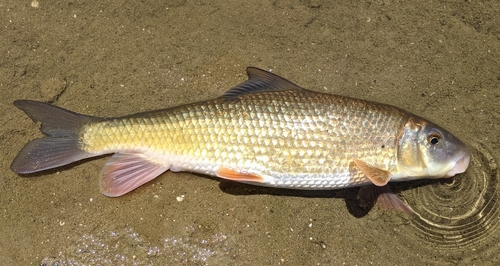
Black Redhorse
Moxostoma duquesnei
A shimmering inhabitant of North America's cleanest rivers, the Black Redhorse is a master of the riverbed. Known as a 'sentinel species,' its presence signals a healthy and vibrant aquatic ecosystem.
Quick Identification
Size
Length 25–46 cm (10–18 inches); Weight 0.5–1.5 kg (1–3.3 lbs)
Colors
Olive-bronze to slate-black upper body with silvery-white underside; fins are typically dusky or gray, lacking the red tint of relatives.
Key Features
- Slate-gray tail fin with no red coloration
- Slender, cylindrical body profile
- Fleshy, downward-facing mouth with pleated lips
- 44 to 47 scales along the lateral line
When You’ll See Them
Geographic range
Where Does the Black Redhorse Live?
Native to the North American continent, the Black Redhorse occupies a vast range throughout the eastern United States and parts of Southern Ontario, Canada. It is most frequently encountered within the Mississippi River and Great Lakes drainages, with notable populations stretching from the Ozarks to the Appalachian Mountains. Because it requires high-quality, clear water, its presence is often used by biologists as a sign of a healthy, thriving river ecosystem.
Basemap © OpenStreetMap contributors
Behavior
The Black Redhorse is a bottom-dwelling specialist that acts as a primary indicator of excellent water health. Unlike some of its hardier relatives, this fish is highly sensitive to siltation and pollution, preferring the clean, oxygen-rich currents of medium-sized rivers. They are generally peaceful and spend their days cruising the riverbed in small groups, using their sensitive lips to vacuum up food from between rocks.
During the spring spawning season, their behavior becomes much more energetic. They migrate to shallow, gravel-bottomed riffles where males congregate to defend small territories. While they are wary of sudden movements, they often ignore stationary observers or submerged cameras, making them excellent subjects for patient underwater photographers and nature enthusiasts.
EverydayEarth exclusive
Camera Tips
Capturing the Black Redhorse requires an underwater approach, as their subtle colors often blend into the riverbed when viewed from above. For the best results, use a waterproof action camera or a trail camera with a high-quality underwater housing. Submerge the camera at the edge of a 'run'—the area where a riffle transitions into deeper, calmer water. Secure the camera to a heavy flat rock or a specialized weighted mount to prevent it from being swept away by the current.
Angle your camera slightly upward and across the current. This positioning captures the fish in profile as they move upstream, highlighting their distinctive lip structure and scale patterns. Natural lighting is your best friend; position the camera so the sun is behind it or directly overhead to avoid harsh glares and shadows that can occur in shallow water. If your camera allows for manual white balance, set it for underwater conditions to correct the blue or green tint of the river.
Timing is everything for the Black Redhorse. The peak window for activity is during the spring spawning run, typically when water temperatures hit 55-65°F (13-18°C). During this time, they move into very shallow gravel bars, often only a few inches deep, providing a unique opportunity to film them in high-energy social groups. Look for 'clean' patches of gravel where they have cleared away algae; these are active spawning sites where you are guaranteed action.
While you cannot easily bait these fish like a mammal, you can attract them by gently disturbing the substrate upstream of your camera just before you leave. This mimics the natural action of a foraging animal and releases insect larvae into the drift, which may draw a curious Black Redhorse directly into your frame. Ensure your camera is set to a high frame rate (at least 60fps) to catch the rapid 'vacuuming' motion of their mouths as they feed.
Similar Species
Species that look similar or are commonly confused with Black Redhorse.
Golden Redhorse
Has a more bronze/golden sheen and fewer lateral line scales (39-42) compared to the Black Redhorse.
Shorthead Redhorse
Features a distinctly bright red tail fin and a much smaller, more triangular head.
Silver Redhorse
Has a deeper body shape and a much larger, more robust head with a more pronounced snout.
Frequently Asked Questions
Record Black Redhorse at your habitat
Connect a camera to start building your own species record — AI identifies every visitor automatically.