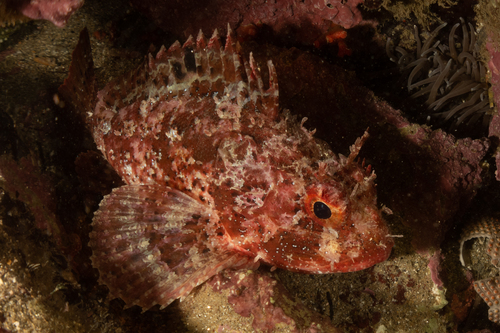
Black Scorpionfish
Scorpaena porcus
A master of underwater disguise, the Black Scorpionfish blends perfectly into the rocky reefs of the Mediterranean. Armed with venomous spines and a lightning-fast strike, it is one of the most effective ambush predators in the coastal Atlantic.
Quick Identification
Size
Usually 15–25 cm (6–10 in) in length, reaching a maximum of 37 cm (14.5 in); weights up to 800g (1.7 lbs).
Colors
Mottled brownish-black or dark reddish-brown body; lighter underside; distinct dark spots on the caudal (tail) fin.
Key Features
- Fringed tentacles (cirri) above the eyes
- Large, bony head with numerous spines and ridges
- Venomous dorsal fin rays used for defense
When You’ll See Them
Geographic range
Where Does the Black Scorpionfish Live?
The Black Scorpionfish is native to the temperate and subtropical coastal waters of the Eastern Atlantic Ocean and the Mediterranean basin. Its range extends from the southern British Isles down to the Azores and Canary Islands, hugging the Moroccan coastline. It is also a very common resident throughout the entirety of the Mediterranean Sea and the Black Sea, where it thrives in the oxygen-rich, rocky coastal zones.
Basemap © OpenStreetMap contributors
Behavior
The Black Scorpionfish is a master of camouflage, spending most of its life sitting perfectly still on the seafloor. As a classic ambush predator, it relies on its cryptic coloration to blend into rocky reefs and seagrass meadows, where it waits for unsuspecting prey to wander too close. It is a solitary species that is significantly more active at night, moving slowly across the bottom using its pectoral fins to 'walk' or make short, quick lunges.
Interactions with humans are generally passive, as the fish will remain motionless even when approached by divers. However, they possess venomous spines along their dorsal, anal, and pelvic fins that can inflict a very painful (though rarely fatal) sting if stepped on or handled. They are not aggressive, but their reliance on camouflage makes them a hidden hazard for coastal explorers in rocky areas.
EverydayEarth exclusive
Camera Tips
To capture the elusive Black Scorpionfish, you will need a dedicated underwater housing for your camera or a specialized waterproof action camera. Because these fish are often found near docks, piers, or shallow rocky shorelines, you can mount your camera on a weighted base or a short tripod and submerge it in areas with plenty of crevices and seaweed. Angle the lens slightly upward or parallel to the sea floor to capture their silhouette and textured skin against the background.
Since Black Scorpionfish are primarily nocturnal, your best chance of seeing activity is during the night. Use a waterproof LED light source with a red filter if possible; many marine species are less startled by red light, and it will provide the illumination needed for the camera's sensor to pick up the fish's intricate mottled patterns. Position the light about 30 to 50 centimeters away from the camera lens to avoid 'backscatter,' which occurs when light reflects off particles in the water directly into the lens.
These fish are ambush predators and spend long periods completely motionless, which can make motion-triggering difficult for some AI cameras. To combat this, set your camera to take a short time-lapse—one photo every 30 to 60 seconds—or use a high-sensitivity motion setting if your software allows it. Look for 'cleaning stations' or narrow rocky gaps where these fish like to hole up during the day; they often return to the same spots, providing a reliable location for your camera trap.
If you are setting up your camera from a private pier or dock, consider lowering a small mesh bag of crushed shellfish or oily fish like sardines nearby. While Black Scorpionfish are visual hunters, the scent will attract smaller fish and crabs, which in turn will draw the scorpionfish into your camera's field of view. Be sure to secure all equipment with a safety tether to a fixed point on land to prevent losing your gear to heavy currents or tides.
Similar Species
Species that look similar or are commonly confused with Black Scorpionfish.
Frequently Asked Questions
Record Black Scorpionfish at your habitat
Connect a camera to start building your own species record — AI identifies every visitor automatically.