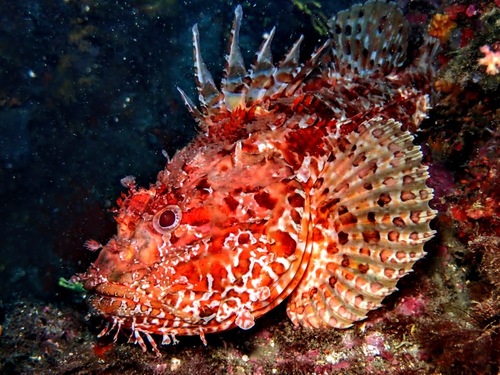
Red Scorpionfish
Scorpaena scrofa
Meet the master of underwater disguise. The Red Scorpionfish is a 'living rock' that uses stunning camouflage and venomous protection to rule the Mediterranean reefs.
Quick Identification
Size
Typically 20-30 cm (8-12 inches), with maximum lengths reaching 50 cm (20 inches). Weight usually ranges between 1-3 kg (2.2-6.6 lbs).
Colors
A vibrant but mottled palette of deep red, bright orange, and pale pink, accented with dark brown or black spots. They feature complex patterns that mimic algae-covered rocks.
Key Features
- Massive, bony head covered in venomous spines and ridges
- Fleshy skin flaps (cirri) located on the chin and above the eyes
- Large, fan-like pectoral fins used for stabilizing on the seabed
- Deep notch in the dorsal fin which contains potent venom glands
When You’ll See Them
Behavior
The Red Scorpionfish is the ultimate 'sit-and-wait' predator. It spends the vast majority of its life perfectly motionless on the seafloor, relying on its incredible camouflage to remain invisible to both predators and prey. Unlike many other fish, it does not have a swim bladder, which allows it to remain heavy and stable on the bottom without floating upward.
While they appear sluggish, they are capable of explosive movement. When a smaller fish or crustacean wanders within range, the Red Scorpionfish opens its cavernous mouth so quickly it creates a vacuum, sucking the prey inside in a fraction of a second. They are solitary creatures and are generally not aggressive toward humans, though their venomous spines serve as a formidable defense against anything that steps on or tries to grab them.
EverydayEarth exclusive
Camera Tips
To successfully capture the Red Scorpionfish on an underwater trail camera, you must focus on the benthos—the very bottom of the sea. These fish are sedentary, so your camera needs a stable, weighted base or a dedicated 'sand-anchor' to prevent it from drifting with the current. Position your lens at a low angle, roughly 15 to 20 centimeters above the substrate, tilting slightly downward. This 'eye-level' perspective captures the intricate textures of their skin flaps and the menacing profile of their venomous dorsal spines.
Strategic placement is key. Look for 'ecotones,' or transition zones, where a rocky reef meets a sandy patch or a seagrass meadow. Red Scorpionfish love to sit at the base of large rocks where they can blend into the shadows. Because they can remain perfectly still for hours, standard motion-detecting triggers may struggle. We recommend setting your camera to a hybrid mode: use a high-sensitivity motion trigger combined with a time-lapse setting (one photo every 5-10 minutes). This ensures you don't miss them if they are simply sitting still, while the motion trigger will catch the explosive 'suction-feeding' strikes when prey wanders too close.
Since this species is most active during the twilight hours and at night, lighting is your biggest challenge. Avoid high-power white strobes, which can cause significant 'backscatter' from plankton and suspended sediment, resulting in a snowy image. Instead, use external red-light LEDs or infrared illuminators if your camera supports them. Many marine organisms, including the Red Scorpionfish's prey, cannot see red light well, allowing you to film natural hunting behaviors without disturbing the scene. If you are using bait to attract subjects, place a mesh bag of oily fish or crushed crustaceans about a meter away from the lens to draw in the small reef fish and crabs that the Scorpionfish preys upon.
Similar Species
Species that look similar or are commonly confused with Red Scorpionfish.
Frequently Asked Questions
Record Red Scorpionfish at your habitat
Connect a camera to start building your own species record — AI identifies every visitor automatically.