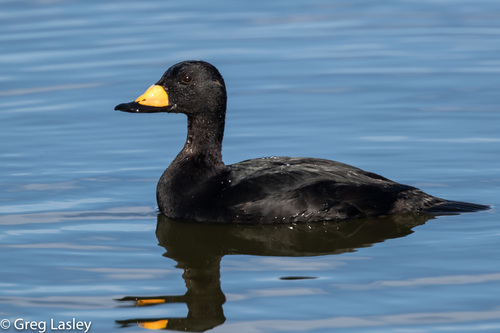
Black Scoter
Melanitta americana
The Black Scoter is a master of the northern seas, known for its velvety black plumage and a hauntingly beautiful whistle that cuts through the ocean mist.
Quick Identification
Size
Length 43–49 cm (17–19 in); Wingspan 71–84 cm (28–33 in); Weight 800–1,200 g (1.8–2.6 lbs)
Colors
Males are entirely velvety black with a bright orange-yellow knob at the base of the bill; females are dusky brown with a dark cap and contrasting pale tan cheeks.
Key Features
- Velvety all-black plumage on males
- Bulbous orange-yellow knob at the base of the bill
- Pale, contrasting cheek patches on females and juveniles
- Pointed tail often held upright while swimming
- High-pitched whistling flight call
When You’ll See Them
Geographic range
Where Does the Black Scoter Live?
The Black Scoter is a hardy traveler of the Northern Hemisphere, with its primary range spanning across North America and eastern Siberia. In the West, they breed across the remote subarctic tundra of Alaska and northern Canada, particularly around the Hudson Bay. When winter arrives, they migrate south to the ice-free coastlines, lining the Pacific coast from the Aleutian Islands down to Baja California, and the Atlantic coast from Newfoundland all the way to Florida.
Basemap © OpenStreetMap contributors
Behavior
Black Scoters are highly social sea ducks, famous for the constant, melodic whistling sounds made by the males during the winter months. Unlike many other waterfowl that are relatively quiet, these birds are quite vocal, often being heard long before they are spotted against the dark ocean waves. They are gregarious birds, forming large, tight-knit rafts that bob just beyond the breaking surf, often diving in synchronized groups to forage on the sea floor.
These ducks are expert divers, using their powerful webbed feet to reach depths of up to 30 feet in search of food. They are generally wary of human interaction and are quick to take flight if approached by boats. During the breeding season, they transition from the salty coastal spray to the quiet freshwater lakes of the tundra, where they become much more secretive while nesting in the dense shoreline vegetation.
EverydayEarth exclusive
Camera Tips
Capturing Black Scoters requires a specialized setup because they rarely leave the water. For coastal properties or lakeside summer homes, the most effective strategy is to mount your AI camera on a low-profile tripod or a secure rock overlooking the 'surf zone'—the area just beyond where waves break. Aim the lens slightly downward to minimize sky glare, which can overexpose the bird's dark plumage. Since these ducks are exceptionally sensitive to movement, camouflage your camera housing using local seaweed, driftwood, or rocks to ensure it blends seamlessly into the shoreline.
Lighting is critical for identifying this species on film. The male's all-black body can easily become a 'silhouette' in mid-day sun. To get the best results, prioritize the early morning hours when the low angle of the sun illuminates the bright orange bill knob of the male and the subtle facial contrasts of the female. If your camera allows for manual exposure, slightly underexposing the shot can help preserve the fine details in their dark feathers and prevent the water's surface from blowing out the highlights.
While you cannot attract sea ducks with traditional birdseed, you can increase your detection rates by placing cameras near known shellfish beds or rocky jetties where mussels are abundant. If you are monitoring a freshwater breeding site, look for calm inlets with overhanging willow or alder branches; females often lead their ducklings through these sheltered shallows. Set your camera to a burst photo mode or high-frame-rate video to capture their rapid diving behavior and the spectacular 'wing-flapping' displays they perform after resurfacing.
Similar Species
Species that look similar or are commonly confused with Black Scoter.
Frequently Asked Questions
Record Black Scoter at your habitat
Connect a camera to start building your own species record — AI identifies every visitor automatically.