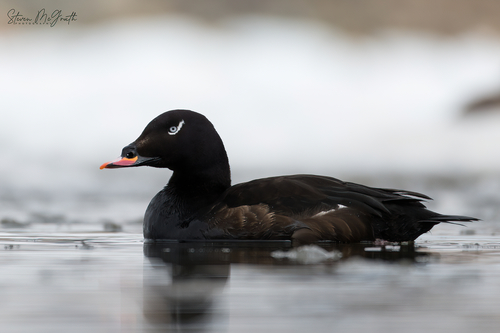
White-winged Scoter
Melanitta deglandi
The White-winged Scoter is the 'heavyweight' of the sea duck world, easily recognized by its velvet-black coat and secret flashes of white. A master of the surf, this hardy diver thrives in the cold, wind-swept waters of the North American coastline.
Quick Identification
Size
Length: 48–60 cm (19–24 in); Wingspan: 86–104 cm (34–41 in); Weight: 1,000–2,100 g (2.2–4.6 lb)
Colors
Males are velvety black with a white comma-shaped eye patch and white wing speculum; females are dark brown with pale facial patches and a matching white wing speculum.
Key Features
- Bright white rectangular wing patch visible in flight
- Distinctive white 'comma' or 'teardrop' marking under the male's eye
- Sloping profile with a large, orange-tipped bill featuring a black hump at the base
- Sturdy, heavy-bodied silhouette often seen low over the water
When You’ll See Them
Geographic range
Where Does the White-winged Scoter Live?
Native to North America, the White-winged Scoter maintains a massive range that shifts seasonally across the continent. During the summer months, they are found breeding primarily in the northwestern interior, spanning from Alaska through central Canada and down into the northern Great Plains of the United States. As winter approaches, they migrate to the coastal edges of the continent, occupying the Pacific coast from the Aleutian Islands to Baja California, and the Atlantic coast from the Gulf of St. Lawrence down to the shores of the Carolinas.
Basemap © OpenStreetMap contributors
Behavior
White-winged Scoters are highly social sea ducks, frequently gathering in large, dense flocks known as rafts when wintering along the coast. They are incredibly powerful swimmers and expert divers, using their partially opened wings to 'fly' underwater in search of shellfish. Unlike many other ducks, they are relatively wary of human activity and tend to stay several hundred yards offshore, though they may move closer to piers or breakwaters during calm weather or when food is abundant.
During the breeding season, their behavior shifts as they migrate inland to secluded freshwater lakes. They are typically quiet birds, but during courtship, the males perform elaborate displays involving head-shaking and short, whistling calls. Because of their heavy build, they require a long 'runway' to take off, pattering their feet across the water’s surface for a significant distance before becoming airborne.
EverydayEarth exclusive
Camera Tips
To capture the White-winged Scoter on camera, placement is everything. If you have a backyard or property bordering a coastal bay or a large northern lake, position your AI-powered camera on a low-profile tripod near the shoreline or on a dock. Angle the lens slightly upward to account for the waterline, and try to place it in a spot where the morning sun will be at your back. This lighting setup is crucial for capturing the iridescent sheen of the male's velvet-black plumage and the sharp contrast of his white eye marking.
Since these ducks are easily spooked by movement, use natural camouflage like driftwood, beach grass, or rocks to break up the silhouette of your camera housing. Scoters are most active during the daylight hours, particularly in the mid-morning when they are actively foraging. Setting your camera to a high-speed burst mode is highly recommended; this will allow you to catch the split-second action of a duck diving or the dramatic spray of water as they patter across the surface during takeoff.
While traditional bird feeders won't attract this species, you can increase your chances of a sighting by monitoring local tide charts. They often move closer to the shore during rising tides to access mollusk beds in shallower water. If you are using a trail camera in their inland breeding grounds, focus on small clearings near the edges of freshwater lakes where the brush is thick, as they prefer to nest on the ground well-hidden by vegetation.
Similar Species
Species that look similar or are commonly confused with White-winged Scoter.
Surf Scoter
Lacks the white wing patch of the White-winged Scoter and has prominent white patches on the forehead and back of the neck.
Black Scoter
The only scoter with no white markings at all on the body; males have a very bright bulbous yellow-orange knob at the base of the bill.
Velvet Scoter
The Eurasian counterpart to the White-winged Scoter; nearly identical but found in Europe and Asia, with slight differences in bill shape.
Frequently Asked Questions
Record White-winged Scoter at your habitat
Connect a camera to start building your own species record — AI identifies every visitor automatically.