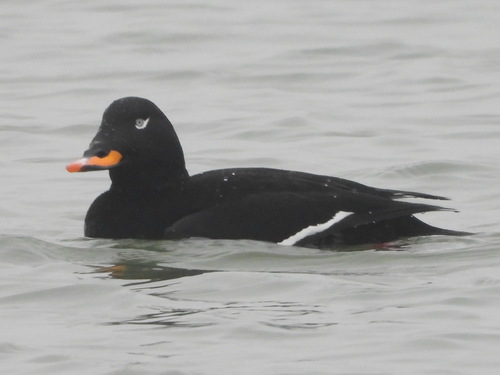
Velvet Scoter
Melanitta fusca
A hardy voyager of the northern seas, the Velvet Scoter is a striking diver known for its jet-black feathers and brilliant white wing flashes. Watch for these resilient ducks as they transition from Arctic tundra lakes to the choppy waves of the coast.
Quick Identification
Size
Length: 51–58 cm (20–23 in); Wingspan: 90–99 cm (35–39 in); Weight: 1.2–1.8 kg (2.6–4.0 lb)
Colors
Males are velvety jet-black with a white eye-crescent and orange bill tip; females are dusky brown with two pale cheek patches. Both sexes show brilliant white wing patches.
Key Features
- Bulky, large-headed sea duck profile
- Bright white 'speculum' wing patches visible in flight
- Male has a small white teardrop-shaped mark under the eye
- Thick, orange-and-black bill with a swollen base in males
When You’ll See Them
Geographic range
Where Does the Velvet Scoter Live?
The Velvet Scoter is a Palearctic species, with its primary breeding grounds stretching across Northern Europe and Western Siberia. Its core nesting range includes Scandinavia, the Baltic states, and Northern Russia as far east as the Yenisey River. During the winter, these birds migrate to the ice-free coastal waters of the Baltic Sea, the North Sea, and occasionally the Caspian and Black Seas, with small numbers reaching as far south as the Mediterranean coast.
Basemap © OpenStreetMap contributors
Behavior
Velvet Scoters are highly social sea ducks, particularly during the winter months when they form large, dense rafts on the open water. They are specialized divers, capable of reaching significant depths to forage along the seabed. Unlike many other ducks that spring directly into the air, these heavy-bodied birds must run across the water's surface for several meters to gain enough momentum for takeoff. Once in flight, they typically move in long, low-level lines just above the waves.
During the breeding season, their behavior shifts from social to territorial. They migrate to freshwater lakes in the northern taiga and tundra, where they build well-hidden nests on the ground, often under dense vegetation. They are generally wary of human presence and will dive or take flight at the first sign of a disturbance. While they are usually silent at sea, they produce various whistling and croaking sounds during the breeding season.
EverydayEarth exclusive
Camera Tips
To capture the Velvet Scoter on a trail camera, focus on coastal shorelines or the edges of large northern lakes. Because these birds are primarily aquatic and rarely come onto land except to nest, the best placement is on a sturdy tripod at a low angle near the water's edge. Look for sheltered bays or rocky jetties where scoters are known to congregate to feed on mussel beds. Positioning the camera just a foot or two above the high-tide mark provides an intimate perspective that highlights their unique facial markings.
Motion sensors can be tricky over moving water, as waves often trigger false positives. To solve this, utilize your camera's 'time-lapse' or 'field scan' mode, setting it to take a photo every 2 to 5 minutes during the peak daylight hours. This ensures you capture the birds even if they are drifting just outside the sensor's range. Since they are dark-feathered, early morning or late afternoon light—the 'golden hour'—is crucial for capturing the subtle textures of their plumage without blowing out the highlights of the white wing patches.
While you cannot attract Velvet Scoters with traditional birdseed, you can increase your chances by scouting for areas with active shellfish populations. In winter, they often stay a few hundred meters offshore, so a camera with a high-resolution sensor or an optical zoom lens is highly recommended. If you are near a breeding site, focus on thick lakeside vegetation where females might lead their ducklings. Always ensure your equipment is protected with a waterproof housing, especially if it is exposed to salt spray in a marine environment.
Similar Species
Species that look similar or are commonly confused with Velvet Scoter.
Common Scoter
Lacks the white wing patch and the white eye mark found on the Velvet Scoter.
White-winged Scoter
Nearly identical but found in North America; the Velvet Scoter has a differently shaped bill and more restricted white eye patch.
Surf Scoter
Male has large white patches on the forehead and nape, and lacks the white wing patch of the Velvet Scoter.
Frequently Asked Questions
Record Velvet Scoter at your habitat
Connect a camera to start building your own species record — AI identifies every visitor automatically.