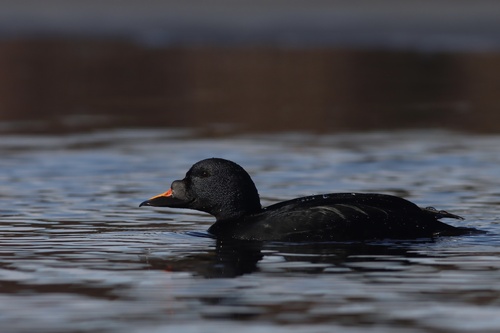
Common Scoter
Melanitta nigra
A sleek, velvety master of the northern waves, the Common Scoter is a deep-diving specialist known for its striking orange-patched bill and vast coastal winter gatherings.
Quick Identification
Size
Length: 43–54 cm (17–21 in); Wingspan: 79–90 cm (31–35 in); Weight: 800–1,200 g (1.8–2.6 lbs)
Colors
Males are velvety black with a bright orange-yellow patch on the bill; females are dark brown with pale greyish cheeks.
Key Features
- Entirely black plumage in males
- Bulbous bill with distinct yellow-orange patch
- Pale, soot-grey cheeks and throat on females
- Short, pointed tail often held upright
- Low-slung profile when swimming
When You’ll See Them
Geographic range
Where Does the Common Scoter Live?
The Common Scoter is native to the northern Palearctic, with its core breeding grounds stretching across Iceland, Scotland, Scandinavia, and northern Russia. During the autumn, these birds undertake significant migrations to reach their wintering ranges along the Atlantic coasts of Europe and North Africa, with high concentrations found in the Baltic and North Seas. While they are most often seen along the shorelines of countries like the United Kingdom, Denmark, and France, some hardy individuals travel as far south as the coastlines of Morocco and Mauritania.
Basemap © OpenStreetMap contributors
Behavior
Common Scoters are highly gregarious sea ducks, famous for forming massive, bobbing rafts that can include thousands of individuals during the winter months. They are master divers, capable of plunging to significant depths to forage for shellfish. While they appear tranquil when floating, they are incredibly energetic beneath the surface, using their powerful webbed feet to propel themselves along the seabed in search of prey.
During the breeding season, their behavior shifts from coastal socialite to secretive moorland dweller. They migrate to remote freshwater lakes and tundra pools, where pairs become territorial and much harder to spot. Their presence is often revealed by the male's melancholic, whistling call, which sounds like a soft 'pü-pü-pü' echoing across the water. They are generally wary of human presence and will take flight in a long, low line over the waves if approached too closely by boats.
EverydayEarth exclusive
Camera Tips
Capturing the Common Scoter on a trail camera requires understanding their seasonal shifts. During the winter, when they are at sea, your best strategy is to set up a camera on a tripod at a high vantage point overlooking a bay or estuary. Use a time-lapse mode rather than a motion trigger, as the distance from the shore often fails to trip standard PIR sensors. Look for 'low energy' days with calm seas to get the clearest shots of their rafts without the interference of heavy spray.
If you are monitoring breeding sites near northern freshwater lakes, place your camera at the water's edge in areas with dense heather or scrub cover. Common Scoters are extremely sensitive to disturbance, so use a camera with a 'no-glow' infrared flash to avoid startling them at night or during the low-light hours of dawn and dusk. Position the lens about 12 inches above the ground to capture the intimate 'eye-level' perspective of a duck swimming past.
For the best results with all-black birds like the male scoter, lighting is everything. Set your camera to face away from the direct sun to avoid harsh silhouettes; soft, overcast light or early morning side-lighting works best to highlight the texture of their feathers and the orange detail on the bill. If your camera supports it, use a high-speed burst mode to capture the action when they dive or perform their whistling courtship displays.
Similar Species
Species that look similar or are commonly confused with Common Scoter.
Black Scoter
The male has a much larger, more prominent bulbous orange-yellow knob at the base of the bill compared to the Common Scoter's flatter patch.
Velvet Scoter
Slightly larger with a distinctive white wing patch (speculum) and a small white 'comma' mark under the eye.
Surf Scoter
The male has striking white patches on the forehead and nape, and a much larger, multi-colored 'heavy' bill.
Frequently Asked Questions
Record Common Scoter at your habitat
Connect a camera to start building your own species record — AI identifies every visitor automatically.