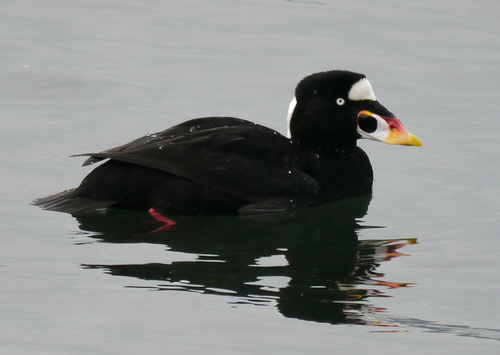
Surf Scoter
Melanitta perspicillata
The Surf Scoter is a bold and hardy sea duck, famous for the male's kaleidoscopic bill and its incredible ability to thrive in the crashing surf of North America's coastlines.
Quick Identification
Size
Length: 45-55 cm (18-22 in); Wingspan: 76-92 cm (30-36 in); Weight: 900-1100g (2.0-2.4 lbs)
Colors
Adult males are velvety black with white patches on the forehead and nape; females are dusky brown with two pale patches on the face.
Key Features
- Sloping, multi-colored bill (orange, white, red, and black) with a large black spot at the base
- Distinctive white patches on the forehead and back of the neck in males
- Square-headed profile with a heavy, swollen bill
- Synchronized diving behavior when foraging in groups
When You’ll See Them
Geographic range
Where Does the Surf Scoter Live?
Native to North America, the Surf Scoter is a true bird of the wilderness, breeding across the remote tundra and boreal forest zones of Alaska and Northern Canada. During the fall, they undertake an impressive migration to the temperate coastlines of the continent. You can find them wintering along the Pacific Coast from the Aleutian Islands down to Baja California, and along the Atlantic Coast from Newfoundland as far south as Florida and the Gulf of Mexico.
Basemap © OpenStreetMap contributors
Behavior
Surf Scoters are energetic sea ducks famously nicknamed "skunk-headed coots" due to the male's striking black and white head patterns. They are exceptionally social birds during the winter months, often gathering in massive, floating flocks called "rafts" that can number in the thousands. These rafts are a spectacular sight along coastlines, particularly when the entire group dives in unison to feed on submerged shellfish beds.
As powerful divers, they use their wings to partially "fly" underwater, reaching depths of up to 30 feet to pry mussels and clams from the seafloor. While they are generally wary of humans, they are frequent visitors to coastal harbors and piers, where they can be observed from a distance. Their flight is fast and low over the water, characterized by a whistling sound produced by their wings.
EverydayEarth exclusive
Camera Tips
To capture the best footage of Surf Scoters, you need to focus on coastal access points. If you have a backyard or property bordering an estuary or bay, position your camera on a low-profile tripod or a specialized fence mount near the high-tide line. Scoters are often found near rocky outcroppings or pier pilings where mussels are plentiful, so aiming your lens at these natural feeding hubs is your best bet for close-up action.
Lighting is the biggest challenge when photographing these birds. Their deep black feathers can easily lose detail in the bright midday sun reflected off the water. For the most professional look, set your camera to capture during the "golden hours"—the first hour after sunrise and the last hour before sunset. This softer, directional light will highlight the intricate orange and red patterns on the male's bill and the subtle brown textures of the female's plumage.
Because Surf Scoters are active divers, use a high-sensitivity motion trigger or a high-frame-rate video setting. They often perform "wing-flaps" or preening rituals immediately after surfacing from a dive, which make for excellent video clips. If your camera allows for zone-based triggering, focus the detection area on the water's surface just beyond the breaking waves.
Finally, consider the tide. These ducks often move closer to the shore as the tide rises to reach fresh mussel beds that were previously too shallow or deep. Check local tide charts and ensure your camera is active during the two hours leading up to high tide. While they don't respond to traditional birdseed, protecting the natural shoreline and keeping the area quiet will encourage them to drift closer to your lens.
Similar Species
Species that look similar or are commonly confused with Surf Scoter.
Black Scoter
The male is entirely black with a bright yellow-orange bulb at the base of the bill, lacking the white head patches of the Surf Scoter.
White-winged Scoter
Features a white 'comma' mark around the eye and large white wing patches that are visible both in flight and when the bird is preening.
Frequently Asked Questions
Record Surf Scoter at your habitat
Connect a camera to start building your own species record — AI identifies every visitor automatically.