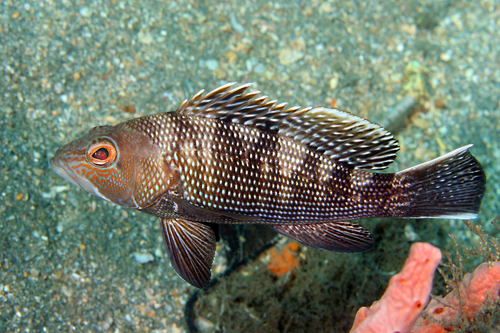
Black Sea Bass
Centropristis striata
The Black Sea Bass is the charismatic 'sentinel' of the Atlantic coast, known for its striking color changes and its habit of guarding rocky underwater fortresses.
Quick Identification
Size
Typically 11 to 24 inches (28–61 cm) in length and weighing 1.5 to 8 lbs (0.7–3.6 kg).
Colors
Smoky grey to dark brown or black with pale white spots forming longitudinal stripes; breeding males exhibit vivid iridescent blue or teal markings on the head.
Key Features
- Stout, thick-set body shape
- Continuous dorsal fin with white spots and stripes
- Rounded tail fin often featuring a long trailing filament in larger adults
- Large, terminal mouth with fine teeth
When You’ll See Them
Geographic range
Where Does the Black Sea Bass Live?
Native to the Western Atlantic Ocean, the Black Sea Bass is found primarily along the eastern coast of the United States. Its core range extends from Cape Cod, Massachusetts, down to Cape Canaveral, Florida, with a distinct sub-population thriving in the eastern Gulf of Mexico. While they are common in temperate coastal waters during the summer, they are known to move to deeper offshore areas as far as the continental shelf edge during the winter months.
Basemap © OpenStreetMap contributors
Behavior
Black Sea Bass are fascinating "protogynous hermaphrodites," meaning most individuals begin life as females and transition into males as they grow larger and social dynamics within the local population shift. They are highly structure-oriented fish, rarely found in open sandy areas, preferring to hover near rocky outcrops, shipwrecks, or pier pilings. This makes them a favorite for underwater camera enthusiasts who have access to dock pilings or artificial reefs.
These fish are relatively bold and curious, often approaching divers or stationary cameras to investigate their surroundings. While they are generally solitary when sheltering in holes or crevices, they can be found in loose aggregations during feeding or spawning. They exhibit a distinct "hovering" posture, using their large pectoral fins to stay nearly motionless above the seafloor while scanning for prey.
Interaction with humans is primarily through recreational fishing and diving. They are known for being aggressive feeders, often striking at lures or bait with significant force. In the winter months, they exhibit a seasonal migration pattern, moving away from the cooling coastal shallows to deeper, more stable waters along the edge of the continental shelf.
EverydayEarth exclusive
Camera Tips
To capture high-quality footage of Black Sea Bass, placement is everything. These fish are structure-dependent, so mount your camera near pier pilings, submerged rock piles, or artificial reef balls. Using a weighted drop-camera rig or a fixed mount on a dock piling about 1-2 feet above the seafloor will provide the best angle for observing their natural behavior as they dart in and out of cover.
Baiting is an extremely effective way to draw Black Sea Bass into the frame. A mesh chum bag filled with crushed clams, squid, or oily fish like mackerel will create a scent trail that these opportunistic hunters cannot resist. For the best visual results, position the bait bag approximately 3-5 feet away from the lens to ensure the fish stay within the camera's focal range without obscuring the view with debris.
Lighting is a major challenge for underwater backyard cameras. If your camera is under a dark dock, use a diffused external light source rather than the camera's built-in LEDs to avoid "backscatter" (reflecting light off floating particles). Black Sea Bass are most active during daylight hours, so aim for mid-morning or early afternoon when the sun is directly overhead to maximize natural light penetration through the water column.
Check your local tide charts and aim for periods of "slack tide" when water movement is minimal. High turbidity or fast currents can make the water cloudy and shake the camera, resulting in blurry footage. During late spring and early summer, look for the spectacular blue "nuchal humps" on the larger males, which signify peak spawning activity and make for stunning colorful captures.
Similar Species
Species that look similar or are commonly confused with Black Sea Bass.
Frequently Asked Questions
Record Black Sea Bass at your habitat
Connect a camera to start building your own species record — AI identifies every visitor automatically.