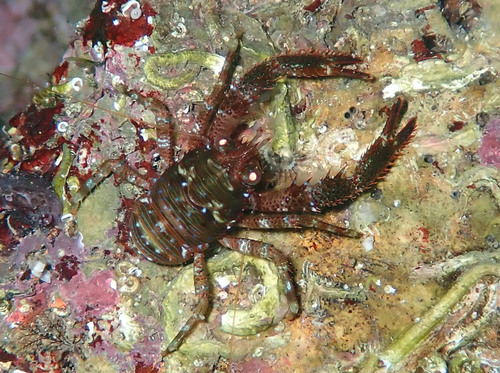
Black Squat Lobster
Galathea squamifera
A hidden gem of the rocky shoreline, the Black Squat Lobster is a master of camouflage and nocturnal survival. With its scale-like armor and striking dark hues, this elusive crustacean brings a touch of deep-sea mystery to the coastal tide pool.
Quick Identification
Size
Total length up to 6.5 cm (2.5 inches) with a carapace length of approximately 3 cm (1.2 inches)
Colors
Dark brownish-black to deep olive green; pincers and body segments may show subtle blue or reddish highlights on the joints and spines
Key Features
- Flattened body with a distinct scale-like texture on the carapace
- Elongated pincers (chelipeds) heavily armed with small spines
- Abdomen is tucked tightly beneath the thorax
- Large, dark eyes positioned on short stalks
When You’ll See Them
Geographic range
Where Does the Black Squat Lobster Live?
The Black Squat Lobster is native to the temperate and subtropical waters of the Northeast Atlantic Ocean and the Mediterranean Sea. Its range extends from the northern reaches of Norway and the British Isles southward to the coasts of Morocco and the Azores. It is particularly abundant along the rugged coastlines of Western Europe, where rocky habitats provide the necessary cover for its survival.
Basemap © OpenStreetMap contributors
Behavior
The Black Squat Lobster is a reclusive and predominantly nocturnal inhabitant of the rocky intertidal zone. Unlike true lobsters that crawl forward, this species is known for its agility and its ability to swim backward rapidly by snapping its abdomen—a behavior known as the 'caridoid escape reaction.' During the day, it remains hidden deep within narrow crevices, under large boulders, or nestled among kelp holdfasts to avoid predation from sea birds and larger fish.
When darkness falls or the tide brings in fresh nutrients, the Black Squat Lobster emerges to forage. It is a territorial creature that uses its long, spiny pincers to signal to rivals and defend its preferred hiding spot. While it may appear aggressive when cornered, it is generally shy and will retreat at the slightest vibration or change in light intensity. To the backyard observer on a coastal property, they represent a hidden layer of biodiversity that only becomes visible with patience and specialized equipment.
EverydayEarth exclusive
Camera Tips
To capture the Black Squat Lobster, you must think like a marine biologist. For coastal backyards, the most effective setup involves a waterproof action camera or an underwater trail camera designed for marine environments. Place your camera during low tide in a permanent tide pool—one that never fully dries out. Secure the camera to a flat rock using a weighted base or heavy-duty suction mounts, ensuring the lens is pointed toward a dark 'cave' or a cluster of loose rocks where these crustaceans are likely to hide.
Since these lobsters are strictly nocturnal, your camera’s low-light performance is paramount. If your device uses infrared (IR) LEDs, be aware that floating particles in the water can cause 'backscatter,' creating a snowy effect in your footage. To avoid this, try to position an external, waterproof light source a few inches away from the camera at a 45-degree angle. This side-lighting technique will highlight the unique scale-like texture of the lobster’s shell and provide much better contrast against the dark rocks.
Using a lure can significantly increase your chances of a sighting. Place a small amount of oily fish, like crushed sardines or mackerel, inside a fine mesh bag and anchor it about 12 inches in front of the lens. The scent will draw the Black Squat Lobster out from its crevice to investigate. Set your camera to record short, high-definition video clips (15-20 seconds) rather than still photos, as their rapid movements and the swaying of seaweed are better captured in motion. Always remember to rinse your camera housing with fresh water after every deployment to prevent salt corrosion.
Similar Species
Species that look similar or are commonly confused with Black Squat Lobster.
Frequently Asked Questions
Record Black Squat Lobster at your habitat
Connect a camera to start building your own species record — AI identifies every visitor automatically.