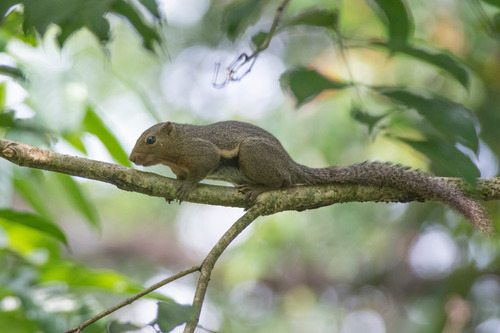
Black-striped Squirrel
Callosciurus nigrovittatus
A master of the Sundaic canopy, the Black-striped Squirrel is easily recognized by its bold 'racing stripes' and energetic leaps. This adaptable rodent is a frequent visitor to Southeast Asian gardens and orchards.
Quick Identification
Size
Head-body length: 17-22 cm (6.7-8.7 in); Tail: 15-20 cm (5.9-7.9 in); Weight: 160-270 g (5.6-9.5 oz)
Colors
Olive-brown or grizzled grey upperparts, greyish to buff belly; side marked with a prominent black stripe above a pale cream/white stripe.
Key Features
- Prominent black side stripe situated directly above a thinner pale cream stripe
- Grizzled olive-brown upperparts and a buff or greyish belly
- Medium-sized bushy tail often held in a curve while foraging
- Darker overall appearance compared to the similar Plantain Squirrel
When You’ll See Them
Geographic range
Where Does the Black-striped Squirrel Live?
Native to the tropical heart of Southeast Asia, the Black-striped Squirrel is widely distributed across the Sundaic region. Its core range encompasses the Malay Peninsula, southern Thailand, and the major Indonesian islands of Sumatra and Java, along with numerous smaller offshore islands. In these regions, it thrives anywhere there is sufficient tree cover, from deep wilderness to the edges of bustling coastal villages.
Basemap © OpenStreetMap contributors
Behavior
The Black-striped Squirrel is a highly active, arboreal specialist that spends the majority of its daylight hours navigating the lower to middle layers of the tropical forest canopy. They are exceptionally agile, using their sharp claws and bushy tails for balance as they leap between branches. Unlike some more secretive forest rodents, this species is quite vocal and may emit sharp chirps or scolding calls when a predator or intruder is detected.
Socially, they are typically observed as solitary foragers or in small family pairs. They are strictly diurnal, with activity peaking in the cooler hours of the early morning and late afternoon. In suburban environments or plantations, they have learned to navigate man-made structures like fences and power lines to move between fruiting trees, often showing a surprising degree of tolerance for human presence if not directly threatened.
EverydayEarth exclusive
Camera Tips
Capturing the Black-striped Squirrel requires a shift in perspective—literally. These squirrels rarely spend time on the forest floor, so mounting your camera at eye level or higher is essential. Aim for a height of 2 to 3 metres (6 to 10 feet) on a tree trunk, or better yet, secure the camera to a sturdy horizontal limb that serves as a natural walkway. Using a strap with a tilt-adjustment wedge will help you angle the lens along the branch to catch the squirrel as it approaches.
Because this species is extremely fast and twitchy, camera settings are critical. Use a 'High' sensitivity trigger setting and a 'Burst Mode' (3-5 photos per trigger) to ensure you capture a clear frame of the animal between its rapid movements. If your camera supports video, short 10-second clips are excellent for capturing their characteristic tail-flicking and vocalizations. Avoid pointing the camera into the sun, as the high contrast can wash out the subtle differences between their black and cream side stripes.
In a backyard or garden setting, you can lure them into the camera's frame using a 'sticky' bait like peanut butter or honey mixed with seeds, smeared directly onto the bark of the tree. This forces the squirrel to stop and lick the bait rather than simply grabbing a nut and running off. Position the bait about 1.5 metres from the lens for the best focus. Early morning, just as the sun begins to pierce the canopy, is the golden window for activity, so ensure your camera is armed and ready before daybreak.
Similar Species
Species that look similar or are commonly confused with Black-striped Squirrel.
Frequently Asked Questions
Record Black-striped Squirrel at your habitat
Connect a camera to start building your own species record — AI identifies every visitor automatically.