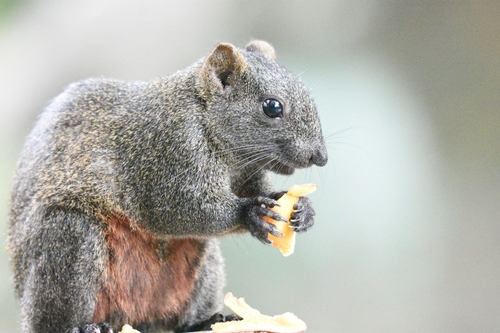
Pallas' Squirrel
Callosciurus erythraeus
With its fiery red belly and incredible acrobatic skills, the Pallas' Squirrel is a charismatic master of the treetops. Originally from the forests of Asia, this clever and vocal rodent has adapted to thrive in gardens and parks across the globe.
Quick Identification
Size
Body length 20–26 cm (8–10 in), tail 17–22 cm (6.5–8.5 in), weight 310–460 g (11–16 oz)
Colors
Olive-brown to grayish-green agouti fur on the back with a distinctive, vibrant chestnut-red or bright orange belly and inner limbs.
Key Features
- Vibrant chestnut-red or deep orange belly
- Speckled olive-brown 'agouti' upperparts
- Bushy tail often tipped with pale or frosted hairs
- Rounded ears without prominent tufts
When You’ll See Them
Geographic range
Where Does the Pallas' Squirrel Live?
Native to the lush and varied landscapes of East and Southeast Asia, the Pallas' Squirrel is widely distributed across China, Taiwan, northern India, Bhutan, and Myanmar. Due to its hardy nature and popularity in the pet trade, it has successfully established introduced populations in several distant corners of the globe. Today, thriving colonies can be found in Japan, Argentina, and parts of Europe, including France, Belgium, and Italy, where they often inhabit suburban parklands and managed forests.
Basemap © OpenStreetMap contributors
Behavior
In urban and suburban settings, these squirrels show incredible adaptability. They often build large, spherical nests called 'dreys' out of twigs, moss, and leaves, typically wedged high in the crotch of a tree for safety. While they are mostly solitary, multiple individuals may be seen in the same area if food is abundant, though they will occasionally engage in high-speed chases to establish dominance.
Their interaction with humans is a mix of charm and mischief. In their introduced ranges, they have gained a reputation for their persistence, often figuring out how to bypass complex squirrel-proof feeders. They are also known for 'bark stripping,' a behavior where they chew the bark off trees to reach the sweet sap underneath, which can sometimes damage ornamental garden trees.
EverydayEarth exclusive
Camera Tips
To capture high-quality footage of the Pallas' Squirrel, place your camera at a height of 4 to 6 feet, ideally facing a horizontal tree limb or a fence top that they use as a regular travel route. These squirrels are creatures of habit and will often follow the exact same path through a garden every day. Set your camera to a fast trigger speed and high frame rate, as their movements are notoriously jerky and rapid; a 'burst' or 'multi-shot' mode is essential to catch that perfect still of them paused with a nut.
Baiting is an effective way to keep these fast-moving mammals in the camera's field of view for longer periods. A platform feeder stocked with walnuts, sunflower seeds, or apple slices works wonders. For a more natural look, you can wedge nuts into the deep crevices of tree bark within the camera's focal range. This encourages the squirrel to stay in one spot and work for the food, giving you ample time to capture the detail of their striking red underparts.
Since they are most active in the early morning and late afternoon, try to position your camera so it isn't facing directly into the rising or setting sun, which can wash out the vibrant colors of their fur. If you are tracking them in the winter, look for 'dreys' (nests) in the trees and point your camera toward the nearest large branch; they will often sun themselves on these branches during the middle of the day to conserve heat. In suburban areas, placing the camera near a water source like a birdbath is also a highly effective tactic, especially during dry summer months.
Similar Species
Species that look similar or are commonly confused with Pallas' Squirrel.
Eurasian Red Squirrel
The Red Squirrel is smaller, has prominent ear tufts during winter, and lacks the olive-green agouti patterning found on the Pallas' Squirrel's back.
Swinhoe's Striped Squirrel
Much smaller with distinct longitudinal stripes down its back, whereas the Pallas' Squirrel has a solid, speckled olive-brown back.
Frequently Asked Questions
Record Pallas' Squirrel at your habitat
Connect a camera to start building your own species record — AI identifies every visitor automatically.