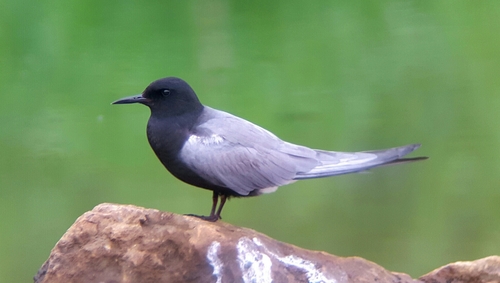
Black Tern
Chlidonias niger
A charcoal-colored gem of the wetlands, the Black Tern is a master of aerial acrobatics. This elegant migrant links the freshwater marshes of the north to the tropical coastlines of the south through its incredible annual journey.
Quick Identification
Size
23-26 cm (9-10 in) length; 57-70 cm (22-28 in) wingspan; 50-60 g (1.8-2.1 oz)
Colors
Breeding adults have a jet-black head, neck, and underbody with slate-gray wings and tail. Non-breeding adults and juveniles are mostly gray above and white below with a distinctive dark patch on the side of the head.
Key Features
- Sooty black head and belly in breeding plumage
- Short, slightly notched tail unlike the deeply forked tails of other terns
- Delicate, slender black bill
- Buoyant, erratic flight style similar to a marsh hawk
When You’ll See Them
Geographic range
Where Does the Black Tern Live?
The Black Tern is a cosmopolitan traveler native to the Northern Hemisphere during the summer and the Southern Hemisphere during the winter. Its breeding range spans across the northern United States and central Canada, stretching across the Atlantic to include much of Europe and Western Asia, particularly Russia and the Caspian Sea region. As the seasons change, these birds undergo a massive migration to the tropical coastlines of South America and Africa, where they gather in large numbers along the rich, productive waters of the equator.
Basemap © OpenStreetMap contributors
Behavior
Black Terns are remarkably agile flyers, characterized by a buoyant and somewhat erratic flight pattern that more closely resembles a swallow or a nighthawk than a typical seagull. Unlike most terns that dive into the water for food, Black Terns are 'dippers' and 'snatchers,' gracefully plucking insects from the air or the water's surface without getting their plumage wet. They are highly social, especially during the breeding season, nesting in loose colonies within the protection of dense marsh vegetation.
These birds are known for their spirited and vocal nature. During the nesting period, they are fiercely territorial and will aggressively dive-bomb any perceived intruders—including humans and larger birds—that venture too close to their floating nests. They communicate with sharp, metallic 'kik' or 'kyew' calls that often signal the presence of a colony before the birds themselves are even seen.
EverydayEarth exclusive
Camera Tips
To capture high-quality footage of a Black Tern, your camera placement should focus on the 'edge' zones of freshwater marshes. Because these birds build floating nests made of decaying vegetation, placing a waterproof trail camera on a sturdy stake just a few inches above the water level in shallow, reedy areas is ideal. Ensure the camera is positioned to face an open pocket of water within the reeds, as this is where they are most likely to land or forage for insects.
Since Black Terns are incredibly fast and have an erratic flight path, traditional motion sensors may struggle to trigger in time. If your camera has a 'high-speed' or 'burst' mode, enable it to ensure you capture the moment of touchdown. A fast shutter speed is essential to prevent motion blur of their dark wings against the bright water. For the best lighting, aim your camera north or south to avoid the direct glare of the sun reflecting off the water during the peak morning and evening activity hours.
While you shouldn't use food bait for these insect-eaters, you can utilize 'habitat baiting' by choosing a location with high dragonfly or damselfly activity. Placing your camera near flowering aquatic plants like water lilies or pickerelweed can increase the likelihood of capturing foraging behavior. Be extremely careful when setting up equipment near nesting colonies; Black Terns are sensitive to disturbance, so use a telephoto lens or remote setup to maintain a respectful distance of at least 20-30 feet from actual nest sites.
Similar Species
Species that look similar or are commonly confused with Black Tern.
White-winged Tern
Breeding adults have strikingly white wings and a red bill, whereas Black Terns have gray wings and a black bill.
Whiskered Tern
Larger than the Black Tern with a distinctive white cheek stripe that contrasts with a dark cap.
Common Tern
Much larger with a deeply forked 'swallow tail' and primarily white/light-gray plumage year-round.
Frequently Asked Questions
Record Black Tern at your habitat
Connect a camera to start building your own species record — AI identifies every visitor automatically.