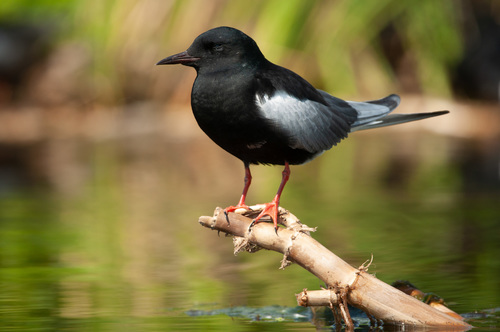
White-winged Tern
Chlidonias leucopterus
With its striking jet-black body and brilliant white wings, the White-winged Tern is a master of the marsh. Discover how to spot this elegant traveler as it dances across the water's surface in search of its next meal.
Quick Identification
Size
Length: 23–27 cm (9–11 in); Wingspan: 58–67 cm (23–26 in); Weight: 53–80 g (1.9–2.8 oz)
Colors
Breeding adults feature a jet-black head and body with contrasting white upper wing coverts and a white tail. Bill and legs are deep red. Non-breeding adults are mostly grey and white with a black ear patch.
Key Features
- Jet-black body and head in breeding plumage
- Stark white upper wings and tail
- Deep red bill and legs
- Light, fluttering flight pattern
- Black underwing coverts visible during flight
When You’ll See Them
Behavior
The White-winged Tern is a graceful and social bird, often seen in large, swirling flocks over freshwater marshes and wetlands. Unlike many coastal terns that dive into the sea for fish, this species is a 'marsh tern,' primarily foraging for insects by hovering over the water surface or picking them off vegetation. Their flight is noticeably lighter and more 'swallow-like' than larger terns, consisting of deep, erratic wingbeats as they navigate over reedbeds.
During the breeding season, they are highly territorial and protective of their nesting sites, but during migration and winter, they become extremely gregarious. They often mix with other marsh terns, such as the Whiskered or Black Tern. While generally shy of direct human contact, they are often found near agricultural drainage canals or suburban lakes, provided there is a healthy population of aquatic insects and minimal disturbance to their feeding zones.
EverydayEarth exclusive
Camera Tips
Capturing the White-winged Tern on a trail camera requires focusing on the water's edge rather than dry land. Because these birds are highly aerial, your best bet is to mount your camera on a sturdy stake or pier about 2–3 feet above the water level, angled slightly upward toward the sky or across a known 'foraging lane.' Look for areas where dragonflies and damselflies are abundant, as these are primary targets. If you have a floating platform or a partially submerged log, these often serve as popular resting spots for the terns to preen, providing a perfect stationary target for your lens.
Since these birds move incredibly fast and have an erratic flight path, traditional motion sensors can sometimes struggle. To maximize your success, use a camera with a 'Burst' or 'Multi-Shot' mode, set to take at least 3-5 photos per trigger. This increases the likelihood of catching a sharp frame mid-hover. If your AI-powered camera allows for 'Activity Zones,' draw your trigger area just above the surface of the water or around a regular perching spot. A high shutter speed is essential to freeze their delicate white wings without motion blur.
Regarding bait, you cannot 'lure' a tern with traditional birdseed. Instead, you must bait the environment. Increasing the local insect population by maintaining healthy aquatic plants or using a safe, UV-light insect trap nearby at night (to draw bugs for the morning) can encourage terns to frequent the area. If you're setting up in a backyard with a large pond, place your camera near the shallow edges where insects emerge from the water. Early morning light is the most flattering for their high-contrast plumage, as it prevents the white wing-tops from looking 'blown out' in the midday sun.
Similar Species
Species that look similar or are commonly confused with White-winged Tern.
Black Tern
Black Terns have grey wings and a grey tail, whereas White-winged Terns have striking white wing coverts and a white tail in breeding plumage.
Whiskered Tern
The Whiskered Tern is generally paler with a white cheek stripe and a grey body, lacking the deep black belly of the White-winged Tern.
Frequently Asked Questions
Record White-winged Tern at your habitat
Connect a camera to start building your own species record — AI identifies every visitor automatically.