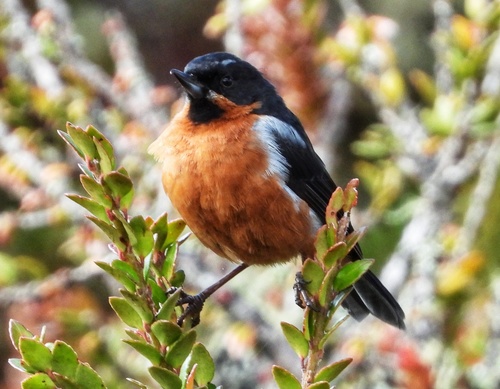
Black-throated Flowerpiercer
Diglossa brunneiventris
The ultimate Andean nectar thief, the Black-throated Flowerpiercer is a bold and colorful high-altitude specialist that brings life to mountain gardens.
Quick Identification
Size
14-15 cm (5.5-6 in) in length; weighs approximately 10-14 g (0.35-0.5 oz)
Colors
Jet black throat, face, and upperparts; rich chestnut-rufous belly and flanks; small but distinct silvery-blue shoulder patches
Key Features
- Sharply hooked upper mandible with a notched lower bill
- Deep chestnut underparts contrasting sharply with a black throat
- Small blue-grey patch on the shoulder (lesser coverts)
- Active, restless foraging behavior
When You’ll See Them
Geographic range
Where Does the Black-throated Flowerpiercer Live?
The Black-throated Flowerpiercer is a quintessential inhabitant of the South American Andes, thriving in high-elevation environments where other species might struggle. Its core range extends from the northern reaches of Peru through the mountainous spine of Bolivia, reaching into northern Chile and extreme northwestern Argentina. These birds are most commonly encountered in the temperate and alpine zones, often making themselves at home in the lush, flowering gardens of Andean mountain towns.
Basemap © OpenStreetMap contributors
Behavior
The Black-throated Flowerpiercer is a high-altitude dynamo, known primarily for its unique and somewhat 'mischievous' feeding strategy. Unlike hummingbirds that reach deep into a flower's corolla to pollinate, this species uses its specialized hooked bill to pierce the base of tubular flowers. This allows it to 'steal' nectar without providing the service of pollination, a behavior that makes it a fascinating subject for backyard observation in Andean regions.
Socially, these birds are quite territorial and bold. They are often seen chasing away other nectar-feeders, including larger hummingbirds, from choice flowering shrubs. While they are not overly shy around human settlements, they are constantly in motion, darting from branch to branch with a flick of the tail, making them a delightful challenge for wildlife photographers and backyard observers alike.
EverydayEarth exclusive
Camera Tips
To capture the Black-throated Flowerpiercer on camera, your primary focus should be on their 'nectar trail.' Position your AI-powered camera within 2 to 4 feet of tubular-flowered shrubs such as Salvia, Fuchsia, or Brachyotum. Because these birds are smaller than many garden visitors, mount the camera at a height of approximately 3 to 5 feet, angled slightly downward toward the clusters of flowers where they are most likely to land and pierce the blooms.
If you use a hummingbird feeder, you have a high chance of attracting them, but they won't hover like a hummingbird. Instead, they will perch on the feeder's edge or the hanger itself. Set your camera's trigger sensitivity to high and use a fast shutter speed (at least 1/1000s if manual settings are available) to freeze their rapid movements. High-definition video mode is often better for this species to capture the unique way they use their hooked bill to manipulate flowers.
Lighting in the high Andes can be harsh and create deep shadows. For the best results, position your camera facing north or south to avoid the direct glare of the morning and evening sun. If your camera setup allows for an external battery or solar panel, utilize it; these birds are active throughout the day, and you'll want your gear ready for the late-afternoon activity spike when they are most territorial and vocal.
Similar Species
Species that look similar or are commonly confused with Black-throated Flowerpiercer.
Glossy Flowerpiercer
Lacks the rufous belly; it is entirely black except for the silvery-blue shoulder patches.
Moustached Flowerpiercer
Features a prominent white 'moustache' stripe on the face which the Black-throated lacks.
Masked Flowerpiercer
Has bright crimson eyes and a deep blue body, looking significantly different despite the similar bill shape.
Frequently Asked Questions
Record Black-throated Flowerpiercer at your habitat
Connect a camera to start building your own species record — AI identifies every visitor automatically.