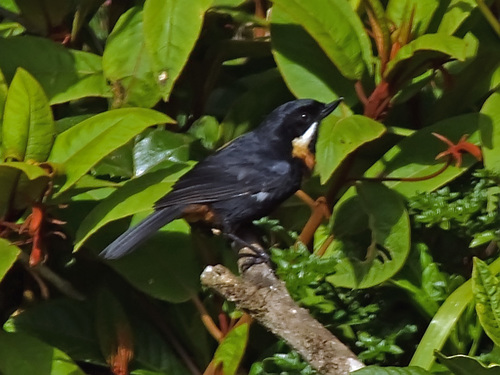
Moustached Flowerpiercer
Diglossa mystacalis
A dapper specialist of the high Andes, the Moustached Flowerpiercer is famous for its bold white facial markings and its clever, 'nectar-robbing' lifestyle. This striking bird is a master of the mountain scrub, turning every garden into its own personal buffet.
Quick Identification
Size
Length of 14.5 cm (5.7 in); weight ranges from 11-15 g (0.4-0.5 oz)
Colors
Deep black body with a prominent, contrasting white malar stripe (the 'moustache'); subtle bluish-grey shoulder patches on the wings; dark eyes and a black bill.
Key Features
- Distinctive white facial stripe extending from the bill
- Sharply hooked bill designed for piercing flowers
- Deep black plumage with blue-grey wing highlights
- Active, acrobatic movement through high-altitude shrubs
When You’ll See Them
Geographic range
Where Does the Moustached Flowerpiercer Live?
This bird is a native of the South American Andes, dwelling in the high-elevation corridors of the continent. It is primarily found along the eastern slopes of the mountain range, with its core populations residing in Peru and western Bolivia. Because it thrives in the unique moisture-rich environment of the cloud forests and elfin woodlands, it is rarely seen outside of these specific Andean montane zones.
Basemap © OpenStreetMap contributors
Behavior
The Moustached Flowerpiercer is a lively and territorial inhabitant of the Andean highlands. Unlike many nectar-eating birds that assist in pollination, this species is a 'nectar robber.' Using its specialized hooked upper mandible to steady a flower and its needle-like lower mandible to pierce the base, it extracts nectar without ever coming into contact with the plant's pollen. This clever workaround allows it to feed on long, tubular flowers that its bill otherwise couldn't navigate.
These birds are generally solitary or seen in pairs, though they will fiercely defend a rich patch of flowering shrubs from other nectar-feeders, including larger hummingbirds. They are quite comfortable around human-disturbed areas and can often be seen darting through garden hedges or degraded forest edges. Their flight is fast and direct, and they frequently flick their wings while perched, signaling their high-energy nature.
EverydayEarth exclusive
Camera Tips
To successfully capture the Moustached Flowerpiercer on a backyard or trail camera, focus your placement on specific floral 'hotspots.' Look for tubular, bell-shaped flowers like Fuchsia, Brachyotum, or various Ericaceae species. Position your camera about 4 to 5 feet off the ground, aiming at the side of the flower clusters rather than the front; because these birds pierce the base of the flower, a side-profile view is essential to see their unique behavior and identifying 'moustache.'
These birds are incredibly fast, so a camera with a high-speed trigger and a short recovery time is vital. If your AI camera has a 'Burst' or 'Rapid Fire' mode, enable it to ensure you catch the moment the bird engages with the flower. Lighting is also a critical factor; because the bird is primarily black, it can appear as a dark silhouette in deep shade. Try to place your camera in a spot that receives bright, filtered morning light to bring out the white facial stripe and the subtle blue on the shoulders.
While they don't eat seeds, Moustached Flowerpiercers are highly attracted to nectar feeders. If you use a hummingbird feeder, ensure it has a perching rail, as flowerpiercers prefer to stand while they feed rather than hover. Placing a feeder within 5-10 feet of dense shrubbery will make them feel secure enough to visit frequently, providing excellent opportunities for high-quality close-up captures.
Similar Species
Species that look similar or are commonly confused with Moustached Flowerpiercer.
Glossy Flowerpiercer
Lacks the white moustache; has a more uniform shiny black plumage and a red or dark eye depending on the region.
Black Flowerpiercer
Larger and entirely black with no white facial markings; typically found in slightly different habitat zones.
Masked Flowerpiercer
Has a bright blue body with a black mask, looking very different from the primarily black Moustached species.
Frequently Asked Questions
Record Moustached Flowerpiercer at your habitat
Connect a camera to start building your own species record — AI identifies every visitor automatically.