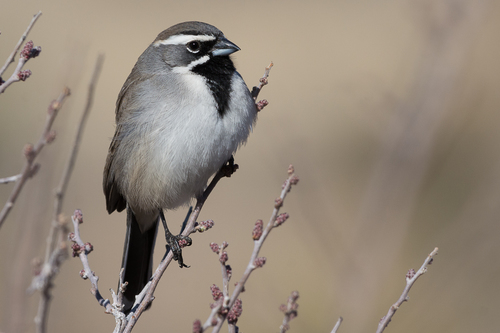
Black-throated Sparrow
Amphispiza bilineata
Meet the dapper 'gentleman' of the desert, a resilient songbird that thrives where others wither. With its sharp black bib and chime-like song, the Black-throated Sparrow is a highlight of any southwestern backyard.
Quick Identification
Size
Length: 4.7–5.5 in (12–14 cm); Wingspan: 7.7 in (19.5 cm); Weight: 0.4–0.5 oz (11–15 g)
Colors
Slate-gray head and back; bright white underparts; bold black triangular throat patch; two distinct white facial stripes (eyebrow and mustache); black tail with white outer corners.
Key Features
- Triangular black throat patch (bib)
- Two crisp white stripes on a gray face
- Black tail with white-tipped outer feathers
- Grayish-brown wings without bold wing bars
When You’ll See Them
Geographic range
Where Does the Black-throated Sparrow Live?
This desert specialist is native to the North American continent, primarily inhabiting the arid southwestern United States and the northern half of Mexico. Its core range includes the Great Basin and the Mojave, Sonoran, and Chihuahuan deserts, stretching from California and Nevada eastward to Texas. While many populations are year-round residents, those in the northernmost reaches of the range may move slightly south during the winter to escape extreme cold.
Basemap © OpenStreetMap contributors
Behavior
The Black-throated Sparrow is a master of the desert, often seen hopping nimbly across the ground in search of seeds. Unlike many other desert birds, it is remarkably well-adapted to aridity and can survive for long periods without drinking water, instead metabolicizing moisture from the seeds and insects it consumes. It is a confident little bird, often allowing observers to get relatively close before flitting into the safety of a nearby creosote or mesquite bush.
During the breeding season, the males become conspicuous performers. They choose the highest available perch—usually the tip of a cactus or a tall shrub—to deliver their sweet, tinkling song that sounds like the chiming of small bells. They are generally territorial during the summer but may form loose, small flocks during the winter months, occasionally joining other sparrow species at foraging sites.
EverydayEarth exclusive
Camera Tips
To capture the best footage of a Black-throated Sparrow, positioning your camera low is key. These birds are ground-foragers, so mounting your device on a short tripod or a ground-level stake about 12 to 18 inches high is ideal. Aim the lens at a flat, sandy patch near the base of desert shrubs like sagebrush or creosote, which they use for cover.
In their arid home, water is the ultimate attractant. If you have a low-profile birdbath or a small ground-level water dripper, focus your camera there. They are much more likely to visit a consistent water source than a hanging feeder. If you do use a feeder, choose a ground-tray style and fill it with fine seeds like white proso millet or sunflower hearts, as they rarely use tube feeders.
Lighting in the desert can be harsh, often washing out the bird's subtle gray tones. Try to orient your camera so the sun is behind it during the early morning hours—their peak activity time. The cool, soft light of dawn will highlight the crisp contrast of their black throat and white facial stripes. Set your camera's trigger sensitivity to high, as these sparrows move with quick, jerky hops that can sometimes be missed by slower sensors.
Similar Species
Species that look similar or are commonly confused with Black-throated Sparrow.
Frequently Asked Questions
Record Black-throated Sparrow at your habitat
Connect a camera to start building your own species record — AI identifies every visitor automatically.