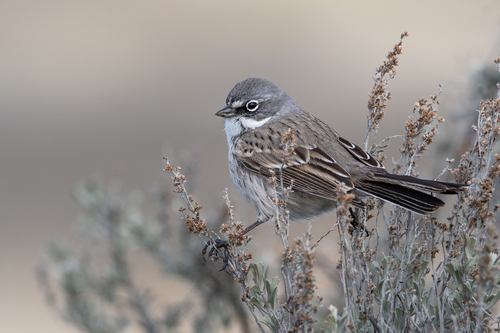
Sagebrush Sparrow
Artemisiospiza nevadensis
Meet the 'phantom of the flats,' a shy desert specialist known for its frantic running and melodic song. The Sagebrush Sparrow is a master of camouflage in the vast, arid basins of the American West.
Quick Identification
Size
4.7-5.9 in (12-15 cm) length; 6.5-7.5 in (16.5-19 cm) wingspan; 0.5-0.7 oz (15-20 g) weight
Colors
Soft gray-brown upperparts, white underparts with a small dark spot on the center of the breast. Head is gray with a white eye-ring and distinct white facial stripes.
Key Features
- Single dark spot on a white breast
- White eye-ring and white 'mustache' stripe
- Long, dark tail often held cocked upward
- Streaked gray-brown back
When You’ll See Them
Behavior
The Sagebrush Sparrow is a master of the ground, preferring to run between shrubs rather than fly when disturbed. It has a quirky habit of cocking its tail upward as it scurries across the desert floor, making it look almost like a miniature roadrunner. While they are social during the winter, forming small flocks, they become highly territorial during the breeding season, with males perching on the highest sagebrush branch to sing their tinkling, melodic song.
They are relatively shy around humans and rarely visit traditional bird feeders unless the property is directly adjacent to undisturbed sagebrush habitat. They spend the vast majority of their time foraging on the ground, scratching through leaf litter and soil under the cover of dense shrubs to find their next meal.
EverydayEarth exclusive
Camera Tips
Capturing the Sagebrush Sparrow on camera requires a ground-level approach. Since these birds spend nearly 90% of their time on the soil, place your AI camera at an ultra-low angle, no more than 4 to 6 inches off the ground. Aim the lens toward an open patch of sandy soil between large sagebrush or bitterbrush plants. These 'corridors' are their preferred highways for moving between cover, and a low-angle shot will capture the bird's unique tail-cocked running posture perfectly.
If you want to lure them into frame, focus on water rather than seeds. In their arid environment, a low-profile ground birdbath or a simple dripping water feature is an irresistible magnet. Position the camera about 3-5 feet from the water source to ensure the motion trigger catches the action. Use a fast shutter speed or high frame rate setting if your camera allows, as these sparrows are incredibly quick and jittery when they feel exposed.
Lighting is crucial in the desert. To avoid harsh shadows that can wash out their subtle gray and white markings, set your camera to face North or South. This prevents the lens from looking directly into the sun during their peak morning and evening activity hours. If your camera has a 'burst' mode, enable it; catching the exact moment they flare their tail or sing from a low perch makes for a much more compelling capture than a static shot.
Lastly, consider the season. During the spring breeding season, males are much more predictable as they will return to the same prominent 'song post' (usually the tallest shrub in their territory) every morning. If you can identify this perch, mounting a camera nearby can provide stunning, eye-level footage of their vocal displays.
Similar Species
Species that look similar or are commonly confused with Sagebrush Sparrow.
Bell's Sparrow
Very closely related but darker overall with more facial contrast; typically found in coastal chaparral rather than interior sagebrush.
Black-throated Sparrow
Shares the same arid habitat but is easily distinguished by a bold, solid black triangular throat patch.
Vesper Sparrow
Has a similar streaked back but features white outer tail feathers and a distinct chestnut-colored patch on the shoulder.
Frequently Asked Questions
Record Sagebrush Sparrow at your habitat
Connect a camera to start building your own species record — AI identifies every visitor automatically.