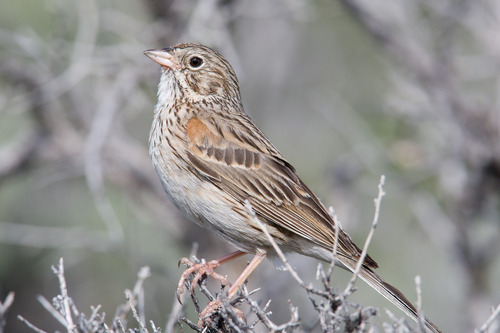
Vesper Sparrow
Pooecetes gramineus
Named for its enchanting evening song, the Vesper Sparrow is a master of the open fields. Look for its distinctive white outer tail feathers as it dances across sun-drenched grasslands and rustic fence lines.
Quick Identification
Size
Length: 5.1-6.3 in (13-16 cm); Wingspan: 9.4-11 in (24-28 cm); Weight: 0.7-1.0 oz (20-28 g)
Colors
Soft grayish-brown with dark streaks; white belly; narrow white eye-ring; distinctive white outer tail feathers visible in flight; subtle chestnut-colored 'shoulder' patches.
Key Features
- White outer tail feathers visible during flight
- Distinct white eye-ring on a streaked face
- Small chestnut/rufous patches on shoulders (lesser wing coverts)
- Finely streaked breast and flanks with a clear white throat
When You’ll See Them
Behavior
The Vesper Sparrow is a classic bird of open landscapes, often seen foraging on the ground or singing from an elevated perch like a fence post or a tall weed. Unlike many other sparrows that prefer dense thickets, the Vesper Sparrow is a bird of the open, thriving in dry grasslands, hayfields, and pastures. They are somewhat solitary during the breeding season but may join loose, small flocks during migration and winter to forage for seeds.
Known for their beautiful song—which traditionally begins with two low, clear notes followed by two higher notes and a series of trills—they are particularly vocal in the late afternoon and evening, a habit that earned them their name (vesper being the Latin word for evening). When disturbed, they typically fly low to the ground in a zig-zag pattern, flashing their white outer tail feathers before landing a short distance away to continue their activities.
EverydayEarth exclusive
Camera Tips
Capturing the Vesper Sparrow on an EverydayEarth camera requires a 'low and slow' approach. Since these birds are primarily ground foragers, your camera should be mounted just 6 to 12 inches off the ground. Aim the lens at a patch of bare earth or short grass adjacent to a fence line or a brushy edge. If you have a trail or a dirt path through an open field, this is a prime location, as they often dust-bathe or search for grit in these spots to help digest their seeds.
To lure them into your camera's field of view, try scattering a 'grassland mix' of seeds, focusing on small millets or cracked corn. For the best results during the breeding season, offering mealworms in a low-profile dish can be highly effective, as the adults are constantly searching for high-protein snacks to feed their young. Ensure the camera is positioned to catch the morning or evening light, as the Vesper Sparrow's subtle gray-brown colors pop beautifully during the 'golden hour,' making the white eye-ring and shoulder patches much easier for the AI to identify.
Placement near a common 'song perch' is another secret trick. Look for a solitary fence post, a large rock, or a tall mullein stalk in an open area. If you mount a camera nearby or use a telephoto-capable lens focused on that perch, you are likely to catch stunning footage of them singing. Set your trigger speed to the highest sensitivity; these sparrows move in quick, nervous hops, and a slow trigger might only capture a tail as they fly away. A 3-shot burst or a 10-second video clip is recommended to capture the flash of their white tail feathers when they take flight, which is their most diagnostic feature.
Similar Species
Species that look similar or are commonly confused with Vesper Sparrow.
Song Sparrow
Lacks the white outer tail feathers and the white eye-ring; typically found in wetter habitats or denser brush.
Savannah Sparrow
Smaller with a shorter tail and often has a yellow 'eyebrow' (supercilium) which the Vesper Sparrow lacks.
Lark Sparrow
Has a much bolder, harlequin-like head pattern and a white-tipped tail, whereas the Vesper's white is only on the outer edges.
Frequently Asked Questions
Record Vesper Sparrow at your habitat
Connect a camera to start building your own species record — AI identifies every visitor automatically.