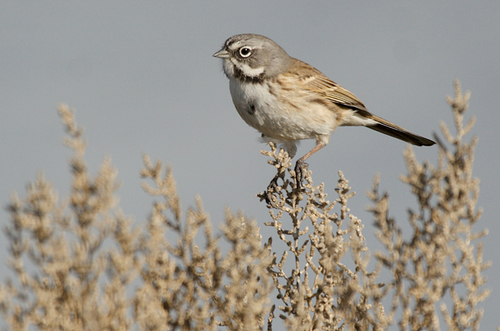
Bell's Sparrow
Artemisiospiza belli
A master of the California chaparral, Bell's Sparrow is a charming bird of the brush known for its 'tail-up' running style and beautiful, tinkling song. This secretive ground-dweller is a prize find for any backyard wildlife enthusiast in the West.
Quick Identification
Size
Length: 13-15 cm (5.1-5.9 in); Wingspan: 19-22 cm (7.5-8.7 in); Weight: 15-22 g (0.5-0.8 oz)
Colors
Soft charcoal-gray head with white eye-rings and white facial stripes; white underparts with a dark central breast spot; grayish-brown back and dark tail.
Key Features
- Dark 'stickpin' spot in the center of the breast
- Distinct white eye-ring and white mustache stripes
- Frequent upward cocking and flicking of the tail
- Runs on the ground rather than flying between low shrubs
When You’ll See Them
Geographic range
Where Does the Bell's Sparrow Live?
Native to the Pacific slope of North America, Bell's Sparrow is a true specialist of the Mediterranean climates found in the Western United States and Northwestern Mexico. Its core population resides in California, spanning from the northern Coast Ranges down through the foothills of the Sierra Nevada. The range continues south across the border into the arid landscapes of the Baja California peninsula, where the birds remain year-round residents.
Basemap © OpenStreetMap contributors
Behavior
Socially, they are usually seen in pairs during the summer but may join loose, mixed-species flocks during the winter months. They are highly territorial when nesting but generally non-aggressive toward humans. Because they rely so heavily on specific types of low-growing brush, their presence is a great indicator of a healthy, intact Mediterranean shrubland ecosystem.
EverydayEarth exclusive
Camera Tips
Water is the ultimate lure for this species, especially in their naturally dry habitats. A ground-level birdbath or a simple recirculating fountain with a shallow edge will attract them much more reliably than a hanging seed feeder. Because they are fast and jerky in their movements, set your camera to a fast trigger speed and use a video mode of at least 30 frames per second to capture their characteristic tail-flicking behavior without blur.
Avoid placing cameras in high-wind areas if possible, as moving branches in the background can trigger 'false positives' on many AI cameras. Early morning is the magic hour for Bell's Sparrows; they are most active just after sunrise when the light is soft enough to highlight the subtle gray and white contrast of their facial markings. If you're using bait, a light scattering of white millet near the base of a shrub can help keep them in the frame long enough for a high-quality identification.
Similar Species
Species that look similar or are commonly confused with Bell's Sparrow.
Sagebrush Sparrow
Paler overall with more distinct streaking on the back; typically found further inland in the Great Basin.
Black-throated Sparrow
Easily distinguished by a large, solid black triangular patch on the throat and chest.
Song Sparrow
Much more heavily streaked overall with a browner complexion and lacks the clean gray head of the Bell's Sparrow.
Frequently Asked Questions
Record Bell's Sparrow at your habitat
Connect a camera to start building your own species record — AI identifies every visitor automatically.