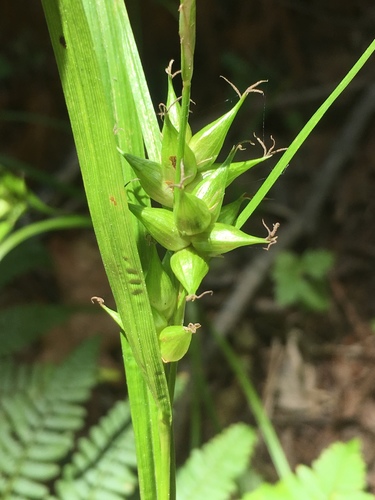
bladder sedge
Carex intumescens
Featuring striking, star-like seed clusters and lush green foliage, bladder sedge is a standout native plant for any shaded, damp corner of your yard. It’s an ecological workhorse that provides shelter for small wildlife while adding a unique texture to the woodland landscape.
Quick Identification
Size
Grows 30–90 cm (12–35 inches) tall, typically forming clumps 25–45 cm (10–18 inches) wide.
Colors
Bright emerald green leaves; seed heads (perigynia) are lime green, turning to golden-tan or straw-colored as they ripen.
Key Features
- Large, inflated, pear-shaped seed sacs (perigynia) clustered at the top
- Stiffly upright, triangular stems characteristic of sedges
- V-shaped leaf blades arranged in three distinct ranks
- Small, inconspicuous flowers that bloom in late spring
When You’ll See Them
Geographic range
Where Does the bladder sedge Live?
Bladder sedge is a quintessential North American native, spanning a wide territory from the boreal forests of eastern Canada down through the entirety of the eastern United States. Its range extends as far west as Manitoba and Texas, though it is most densely concentrated in the Great Lakes region and the Appalachian Mountains. It thrives in temperate zones where consistent moisture and seasonal shade are available.
Basemap © OpenStreetMap contributors
Behavior
Bladder sedge is a perennial, clump-forming plant that plays a quiet but vital role in its ecosystem. Unlike many spreading grasses, it grows in tidy, decorative tufts, making it a non-aggressive resident of woodland gardens and wetlands. It doesn't move, of course, but it reacts beautifully to its environment, with its broad leaves swaying in the breeze and its heavy seed heads bowing the stems as they mature throughout the summer.
As a foundational species in wet forests, it provides essential structure. The dense clumps offer hiding spots for amphibians and ground-nesting birds, while the root system helps stabilize soil in flood-prone areas. For the backyard observer, this species is a reliable sign of a healthy, moisture-rich environment and serves as a host plant for various species of satyr butterflies and moths.
EverydayEarth exclusive
Camera Tips
When setting up an AI-powered camera for bladder sedge, focus on the unique seed heads. These 'bladders' are the most distinctive feature and look best when back-lit by the sun. Mount your camera on a low tripod or a ground stake roughly 12 to 18 inches off the forest floor to capture the plant at 'eye level.' This perspective highlights the architectural shape of the seed clusters against the background foliage.
To capture more than just a static image, use a timelapse setting. This allows you to witness the fascinating progression of the perigynia as they swell from tiny green points into large, inflated sacs. A frame every 4 to 6 hours over the course of two weeks in early summer will create a stunning visual of the plant's reproductive cycle. If your camera has a macro mode, use it to get close-ups of the intricate veins on the seed sacs.
Keep in mind that bladder sedge often grows in shaded areas. Adjust your camera's exposure settings to account for low-light conditions, or place it near a gap in the canopy where 'dappled light' can hit the leaves. Be sure to clear away any dead leaves or distracting sticks from the immediate foreground to keep the focus sharp on the emerald-green blades. Since this plant attracts caterpillars and small insects, your camera may also trigger on these visitors, providing a glimpse into the micro-fauna of your backyard.
Similar Species
Species that look similar or are commonly confused with bladder sedge.
Hop Sedge
Hop sedge has much longer, more cylindrical seed spikes with many more tightly packed perigynia than the loose, few-fruited clusters of bladder sedge.
Gray's Sedge
Gray's Sedge features seed heads that form a perfect, globose 'mace' shape, whereas bladder sedge sacs are more pear-shaped and point upwards or outwards.
Frequently Asked Questions
Record bladder sedge at your habitat
Connect a camera to start building your own species record — AI identifies every visitor automatically.