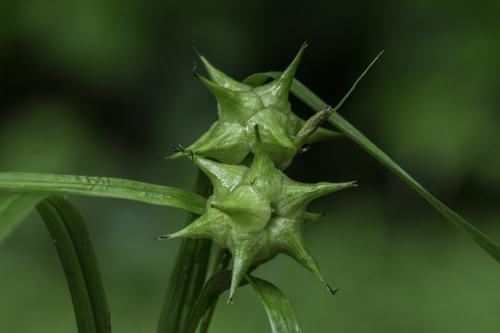
Gray's sedge
Carex grayi
Featuring otherworldly, star-shaped seed heads that look like ancient weaponry, Gray's Sedge is a striking North American native that thrives in the dampest corners of your yard.
Quick Identification
Size
Grows to a height of 60–90 cm (24–36 inches) with a spread of 30–60 cm (12–24 inches)
Colors
Bright lime-green foliage and seed heads; transitions to a golden-tan or bronze in late autumn
Key Features
- Distinctive star-shaped seed heads resembling medieval maces
- Narrow, arching grass-like leaves
- Upright clumping growth habit
- Globular fruit clusters containing 10-30 inflated sacs (perigynia)
When You’ll See Them
Behavior
In a backyard ecosystem, Gray's Sedge acts as a micro-habitat for beneficial insects and a source of food for specialized wildlife. Its dense foliage provides cover for small amphibians like wood frogs or spring peepers, while the seeds provide a high-energy snack for various songbirds and small mammals during the leaner months. It is remarkably resilient, capable of thriving in areas where standing water might kill more delicate garden plants.
EverydayEarth exclusive
Camera Tips
Lighting is a crucial factor for this species because its pale green color can easily wash out in direct midday sun. The best time for photography or video capture is during the 'golden hours'—shortly after sunrise or before sunset. Morning shots are particularly rewarding, as the spiked seed heads are excellent at catching dew or frost, which sparkles beautifully under infrared or natural light. Avoid pointing your camera directly south if the plant is in an open area, as lens flare can obscure the fine textures of the leaves.
Since Gray's Sedge is stationary, it is the perfect candidate for time-lapse mode. Set your camera to take a photo every 30 minutes over several weeks in early summer to watch the seed heads swell and change from pale green to tan. If you are interested in the wildlife that visits the plant, set your trigger sensitivity to 'High.' Small birds like sparrows frequently land on the sturdy stalks to pick at the seeds, and nocturnal mammals like voles often forage around the base. A short 10-second video clip triggered by these movements can reveal a hidden world of activity around this single plant.
In the winter, don't pack your camera away. Gray's Sedge maintains its structural integrity even under a light dusting of snow. The brown, dried 'maces' look spectacular in high-contrast black-and-white winter photos. Position the camera to catch the wind-blown movement of the stalks against a snowy backdrop for a serene, cinematic effect that showcases the plant’s year-round contribution to your backyard's visual appeal.
Similar Species
Species that look similar or are commonly confused with Gray's sedge.
Frequently Asked Questions
Record Gray's sedge at your habitat
Connect a camera to start building your own species record — AI identifies every visitor automatically.