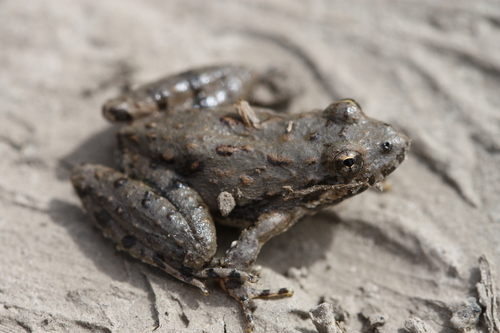
Blanchard's Cricket Frog
Acris blanchardi
The Blanchard's Cricket Frog is a tiny but mighty leaper found along the muddy edges of Midwestern and Southern waterways. Known for a call that sounds like clicking marbles, this warty-skinned acrobat is a sign of a healthy wetland ecosystem.
Quick Identification
Size
1.5 to 3.8 cm (0.6 to 1.5 inches) in length; weighing only a few grams
Colors
Tan, gray, or olive green with a signature dark triangular mark between the eyes; often features a bright green, red, or brown stripe down the spine
Key Features
- Dark triangle between the eyes
- Warty, granular skin
- Blunt snout
- Webbed hind feet for swimming
- Short, powerful legs for jumping
When You’ll See Them
Geographic range
Where Does the Blanchard's Cricket Frog Live?
Blanchard's Cricket Frog is a native fixture of the central North American landscape. Its primary range extends throughout the central United States, from the Great Lakes region in the north down through the Mississippi River Valley to Texas and into northeastern Mexico. While traditionally common, they have faced significant declines in the northernmost parts of their range, particularly in Michigan and Wisconsin.
Basemap © OpenStreetMap contributors
Behavior
Blanchard’s Cricket Frogs are high-energy amphibians known for their exceptional leaping ability, often jumping several feet to escape predators—a distance many times their body length. Unlike many other frogs that are strictly nocturnal, these tiny athletes are active during both the day and night, especially during the warm breeding season. They are highly social during the spring and summer, congregating in large numbers along the muddy banks of ponds and slow-moving streams.
Their life cycle is remarkably fast; most individuals only live for about one year, meaning the population relies heavily on successful annual breeding. While they are technically members of the tree frog family, they have lost their adhesive toe pads and prefer to stay on the ground or in the water. They are generally wary of humans and will quickly leap into the water at the first sign of a shadow or vibration, making them a challenge to spot without a quiet approach.
EverydayEarth exclusive
Camera Tips
Capturing a Blanchard's Cricket Frog on camera requires a specialized setup due to their diminutive size. To get the best results, place your camera extremely low to the ground—ideally on a mini-tripod or a waterproof flat mount—right at the water's edge where mud meets the bank. These frogs love to bask on open mudflats, so aim the lens at a clear patch of earth rather than thick vegetation. If your camera supports a macro lens or has a close-focus setting, ensure it is activated, as you'll want the camera just 12 to 18 inches away from your target area.
Because these frogs are incredibly fast leapers, a standard motion trigger can sometimes miss the action or result in a blur. Use a camera with a very fast trigger speed (0.2 seconds or less) and set it to 'Burst Mode' to capture a sequence of frames. Since they are active during the day, natural lighting is your friend, but ensure your camera is positioned so your own shadow or the camera's silhouette doesn't fall across their basking spot, as they are highly sensitive to overhead movement.
For the best activity, time your camera deployments around rain events during the summer months. Warm, humid nights following a heavy rain will see the highest activity levels. If your camera has audio capabilities, look for areas where you hear a sound like marbles clicking together—this is the male's call. Positioning the camera near these 'calling stations' is the most reliable way to ensure you capture them on video. Avoid using heavy lures or baits, as these frogs hunt live, moving insects; instead, focus on habitat 'hotspots' like a half-submerged log or a flat muddy bank.
Similar Species
Species that look similar or are commonly confused with Blanchard's Cricket Frog.
Northern Cricket Frog
Nearly identical, but the Northern species typically has more extensive webbing on the toes and a slightly different geographic range.
Spring Peeper
Peepers have smooth skin and a dark 'X' on their back, whereas Cricket Frogs are warty and have a triangle on the head.
Boreal Chorus Frog
Chorus frogs have three distinct dark stripes down their back and lack the warty skin of the cricket frog.
Frequently Asked Questions
Record Blanchard's Cricket Frog at your habitat
Connect a camera to start building your own species record — AI identifies every visitor automatically.