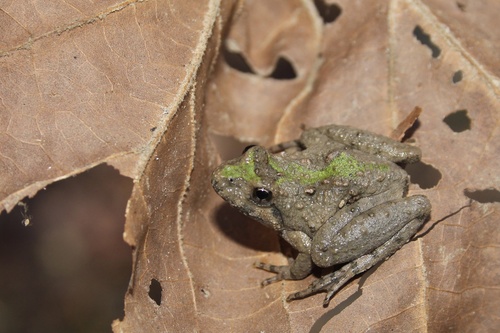
Northern Cricket Frog
Acris crepitans
The Northern Cricket Frog is a pint-sized powerhouse of the wetlands, famous for its marble-like clicking call and incredible three-foot leaps. Though it belongs to the tree frog family, this master of camouflage prefers to keep its feet firmly on the muddy banks of sunlit ponds.
Quick Identification
Size
Small and stocky, ranging from 0.6 to 1.5 inches (1.6 to 3.8 cm) in length.
Colors
Variably colored in shades of grey, green, or brown with irregular blotching. Most individuals feature a bright green, red, or brown stripe down the spine and a dark triangular mark on the head.
Key Features
- Dark triangular marking on the top of the head between the eyes
- Extremely long hind legs capable of leaps over 3 feet
- Warty, sandpaper-like skin texture
- Dark, ragged longitudinal stripe on the back of the thigh
When You’ll See Them
Behavior
Despite being part of the tree frog family (Hylidae), Northern Cricket Frogs are not climbers. They are strictly terrestrial and semi-aquatic, spending almost all their time on the muddy banks of permanent water sources. They are exceptionally athletic; when startled, they perform a series of erratic, zigzagging jumps to reach the safety of the water, where they are also proficient swimmers.
These frogs are primarily diurnal, meaning they are most active during the daylight hours when they can be seen basking in the sun to regulate their temperature. They are social creatures, often gathering in large numbers along shorelines. Their presence is most easily detected by their unique call—a series of sharp clicks that sound like two pebbles or marbles being struck together, starting slowly and increasing in tempo.
EverydayEarth exclusive
Camera Tips
Capturing a Northern Cricket Frog on camera requires a specialized setup due to their diminutive size and ground-level lifestyle. Position your camera extremely low—no more than 3 to 5 inches off the ground. Aim the lens at a flat, sun-exposed 'micro-habitat' like a muddy bank or a flat rock at the water's edge. These frogs love to bask in the sun to stay warm, so identify the spots that receive the most midday light to maximize your chances of a clear shot.
Because these frogs are small and fast, standard motion triggers can sometimes be too slow. If your camera allows, use a high-sensitivity setting and a short trigger interval. Enabling a 'Pre-Trigger' or 'Burst Mode' is highly recommended; cricket frogs are famous for their explosive leaps, and a single photo might only capture a blur. A burst of 3-5 images increases the likelihood of catching them in mid-air or mid-call when their vocal sac is fully extended.
To draw them into your camera’s field of view, try creating an 'ideal' basking spot. Clear a small 12-inch patch of debris to reveal bare mud, or place a flat, dark stone near the water. Avoid using artificial lures or food; instead, focus on habitat. If you have a backyard pond, placing the camera near low-hanging sedges or grasses will capture them as they emerge from cover. Since they are diurnal, you won't need heavy infrared flash during the day, but a camera with a good macro-focusing capability will help reveal the intricate 'marble' patterns on their skin.
Similar Species
Species that look similar or are commonly confused with Northern Cricket Frog.
Southern Cricket Frog
The Southern variety typically has a more pointed snout and the dark stripe on the back of the thigh is more defined and less ragged.
Spring Peeper
Lacks the warty skin and head triangle; features a prominent dark 'X' pattern on the back.
Blanchard's Cricket Frog
Often considered a subspecies; it is generally larger and has a more limited range in the central United States.
Frequently Asked Questions
Record Northern Cricket Frog at your habitat
Connect a camera to start building your own species record — AI identifies every visitor automatically.