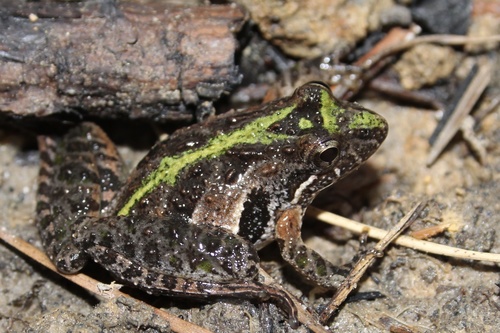
Southern Cricket Frog
Acris gryllus
The Southern Cricket Frog may be small, but its athletic leaps and metallic 'clicking' call make it a giant of the Southeastern wetlands. Watch for this sun-loving amphibian basking along the muddy edges of your backyard pond.
Quick Identification
Size
1.5 to 3.3 cm (0.6 to 1.3 inches) in length; weighs approximately 2 to 4 grams (0.07 to 0.14 ounces)
Colors
Variable colors including gray, tan, or vibrant green, often with a dark triangular mark between the eyes and a dark stripe on the back of the thigh.
Key Features
- Dark triangular mark between the eyes
- Pointed snout and slender body
- Rough, warty skin without large toe pads
- Long hind legs designed for zigzagging leaps
When You’ll See Them
Behavior
The Southern Cricket Frog is a tiny powerhouse known for its incredible jumping ability. Despite being barely an inch long, it can leap distances over 3 feet to escape predators. Unlike many other treefrogs that spend their time high in the canopy, these frogs are primarily ground-dwellers. They are semi-aquatic and are most often found near the muddy edges of ponds, ditches, and wetlands where they can easily retreat into the water if threatened.
These frogs are highly active during the day, especially in sunny weather, which makes them easier to spot than many nocturnal amphibians. They are social creatures, often found in high densities where their collective calls create a deafening chorus. Their call sounds remarkably like two glass marbles being clicked together in rapid succession, starting slowly and accelerating. While they are wary of humans, they are not particularly shy if approached slowly, making them excellent subjects for backyard observation.
EverydayEarth exclusive
Camera Tips
Capturing the Southern Cricket Frog on camera requires a different approach than larger wildlife because of their diminutive size. Since these frogs are only about an inch long, standard PIR (Passive Infrared) motion sensors on trail cameras may fail to trigger. To ensure you catch them in action, set your camera to 'Time-Lapse' mode with a frequent interval (every 1-2 minutes) or use a camera with a high-sensitivity sensor setting. If your camera allows for focal adjustments, set it to a macro or close-up range, as these frogs like to sit still on mudflats or lily pads.
For the best placement, position your camera just 2 to 5 inches off the ground. Point the lens toward the water's edge, specifically targeting sunny patches of mud or flat rocks where they like to bask during the day. Angle the camera slightly downward to maximize the ground-level field of view. Because they are attracted to the insects that swarm around moisture, placing your camera near a backyard water feature or a damp, low-lying area after a rainstorm is a guaranteed way to see them.
If you are filming at night, use a 'Low Glow' or 'No Glow' infrared flash. These frogs are sensitive to light and may stop calling if they are startled by a bright white flash. During the breeding season (late spring and summer), listen for their marble-like clicking sound and place your camera in that general direction. You can also 'bait' an area for photography by leaving a small outdoor light on at night to attract the gnats and mosquitoes that the Southern Cricket Frog loves to eat, though ensure the camera is positioned to capture the ground below the light rather than the light itself.
Similar Species
Species that look similar or are commonly confused with Southern Cricket Frog.
Frequently Asked Questions
Record Southern Cricket Frog at your habitat
Connect a camera to start building your own species record — AI identifies every visitor automatically.