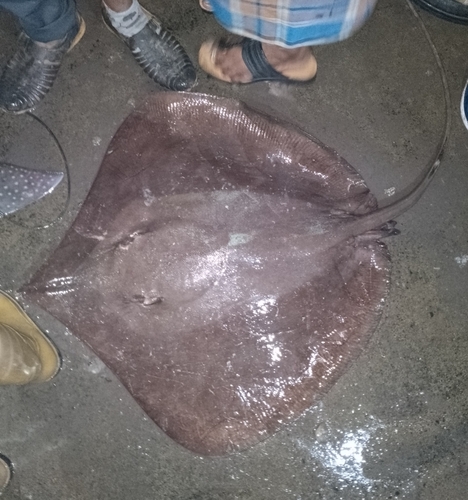
Bleeker's whipray
Pateobatis bleekeri
A graceful dweller of the Indian Ocean's sandy flats, the Bleeker's whipray is a master of camouflage with a tail that stretches far beyond its elegant, triangular body.
Quick Identification
Size
Disc width up to 120-150 cm (47-59 inches); total length including the whip-like tail can reach 3 meters (10 feet)
Colors
Uniform brownish, tan, or greyish-brown on the upper side; underside is a brilliant, clean white
Key Features
- Sharply pointed snout creating a triangular front profile
- Extremely long, whip-like tail that lacks any dorsal or ventral fin folds
- Plain, uniform dorsal coloration without spots or patterns
- Single venomous, serrated spine located toward the base of the tail
When You’ll See Them
Geographic range
Where Does the Bleeker's whipray Live?
Native to the tropical waters of the Indian Ocean, the Bleeker's whipray is a common resident of the continental shelves of South and Southeast Asia. Its core range spans from the eastern coast of India and Sri Lanka through the Bay of Bengal to the shores of Myanmar, Thailand, and Indonesia. These rays are strictly coastal, preferring the nutrient-rich waters where river systems meet the sea, though they rarely venture far into the open ocean.
Basemap © OpenStreetMap contributors
Behavior
The Bleeker's whipray is a master of camouflage and patience, spending much of its day partially buried in the soft substrate of the seafloor. By using its pectoral fins to wave sand over its back, it becomes nearly invisible to both predators and prey, leaving only its eyes and spiracles exposed to the water column. This species is highly sensitive to the environment, using its electroreceptive ampullae of Lorenzini to detect the tiny electrical pulses generated by the muscles of buried crustaceans.
While generally solitary, these rays are known to follow the rhythm of the tides, moving into very shallow flats and estuaries as the water rises to feed. They are not naturally aggressive but are defensive; their primary protection is a venomous tail spine used only when they feel threatened or are stepped on. For coastal residents, they are an iconic sight during calm mornings when the water is clear enough to see them gliding effortlessly over the sand.
EverydayEarth exclusive
Camera Tips
To capture high-quality footage of a Bleeker's whipray, you will need a waterproof action camera or a specialized underwater trail camera capable of handling saltwater environments. The best placement is in the intertidal zone, approximately 1 to 2 meters deep at low tide. Secure your camera to a weighted base or a dock piling, angling the lens slightly downward to cover a wide patch of sandy bottom where rays are likely to forage or bury themselves.
Lighting is critical in underwater photography. Because particles in the water can cause 'backscatter' when hit with direct light, try to place your camera in areas with high natural light penetration or use a diffused external LED. If you are setting up near a dock or pier, the natural shadows can actually attract rays looking for cover, but make sure your camera is positioned to catch them as they enter or exit the shaded area.
For the best results, time your camera deployment with the lunar cycle. These rays are most active during spring tides (the days around a full or new moon) when the increased water movement stirs up the sediment and brings in more prey. If your camera has a time-lapse mode, use it during the rising tide. You can also attract them by placing a securely anchored, perforated bait container filled with crushed sardines or shrimp about two meters from the lens; the scent trail is often enough to bring a curious ray right in front of the camera.
Similar Species
Species that look similar or are commonly confused with Bleeker's whipray.
Frequently Asked Questions
Record Bleeker's whipray at your habitat
Connect a camera to start building your own species record — AI identifies every visitor automatically.