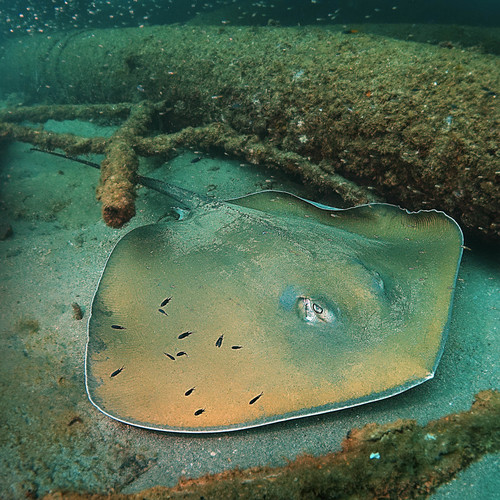
Jenkins' Whipray
Pateobatis jenkinsii
A majestic and sturdy dweller of the Indo-Pacific seafloor, the Jenkins' Whipray is easily identified by its impressive row of spear-like thorns and golden-brown hue.
Quick Identification
Size
Disc width up to 1.5 m (4.9 ft); total length can reach 3 m (9.8 ft) including the tail.
Colors
Uniform yellowish-brown or tan upper surface; white underside; tail becomes grayish past the sting.
Key Features
- Broad diamond-shaped pectoral fin disc
- Row of large spear-like thorns along the dorsal midline
- Heart-shaped dermal denticles between the eyes and tail
- Whip-like tail lacking any upper or lower fin folds
When You’ll See Them
Geographic range
Where Does the Jenkins' Whipray Live?
The Jenkins' Whipray is widely distributed across the warm waters of the Indo-Pacific region. Its territory begins along the southeastern coast of Africa, including South Africa and Mozambique, and extends across the Indian Ocean to the shores of India and Southeast Asia. It is a common sight in the Malay Archipelago and along the tropical northern coastline of Australia, where it thrives in coastal habitats.
Basemap © OpenStreetMap contributors
Behavior
The Jenkins' Whipray is a primarily benthic species, spending much of its time cruising just above the seabed or buried in the substrate. Like many large rays, it is a master of camouflage, using its sandy coloration to blend into the seafloor to avoid predators and surprise prey. It is generally a solitary animal, though it may be found in loose aggregations near productive reef edges or rich feeding grounds.
While typically shy and prone to fleeing when approached by divers or large shadows, this ray is equipped with a venomous stinging spine at the base of its tail for defense. In areas where they overlap with human activity, such as shallow lagoons or estuaries, they are generally docile but require a respectful distance to avoid accidental stings if stepped upon while buried in the sand.
EverydayEarth exclusive
Camera Tips
Capturing the Jenkins' Whipray requires an underwater camera setup, ideally positioned near the sandy margins of coral reefs or in shallow lagoons where these rays frequently forage. If you have access to a private pier or coastal property, mounting a specialized waterproof camera to a dock piling facing a sandy patch can yield excellent results. Because they often bury themselves, look for 'ray pits'—circular depressions in the sand—and aim your camera there.
Since these rays are most active during the low-light hours of dawn and dusk, ensure your camera has high ISO capabilities or use an external underwater light source. A motion-triggering system calibrated for underwater movement can be tricky; it is often better to use a time-lapse setting that takes a photo every 30 to 60 seconds during peak activity periods to catch them as they glide through the frame.
For the best identification shots, try to position the camera at a slightly downward angle to capture the unique heart-shaped denticles and the row of thorns along the midline of their back. Avoid using bright, continuous white lights at night, as this can startle the rays; instead, use red-filtered lights or infrared if your camera supports it, which is less disruptive to their natural behavior.
Similar Species
Species that look similar or are commonly confused with Jenkins' Whipray.
Frequently Asked Questions
Record Jenkins' Whipray at your habitat
Connect a camera to start building your own species record — AI identifies every visitor automatically.