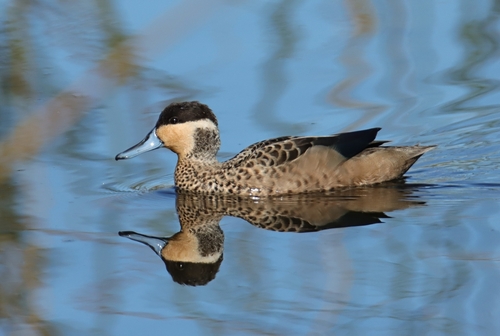
Blue-billed Teal
Spatula hottentota
The smallest dabbling duck in Africa, the Blue-billed Teal is a nomadic jewel of the wetlands. With its stunning sky-blue bill and cream-colored cheeks, it is a favorite for backyard birders across the continent.
Quick Identification
Size
Length: 30–35 cm (12–14 in); Wingspan: 45–50 cm (18–20 in); Weight: 220–250 g (8–9 oz)
Colors
Striking sky-blue bill; dark brown cap contrasting with creamy-buff cheeks; brownish body with dark spots; iridescent green speculum on wings.
Key Features
- Smallest dabbling duck in Africa
- Distinctive pale blue bill with a black tip
- Dark 'skull cap' contrasting with buffy-white face
- Heavily spotted breast and flanks
When You’ll See Them
Geographic range
Where Does the Blue-billed Teal Live?
Native to the African continent, the Blue-billed Teal occupies a massive range stretching from the western regions of Nigeria and Niger across to Ethiopia and Sudan in the east. Its territory extends southward through East Africa into South Africa and Namibia, and it is also a common resident throughout the island of Madagascar. While they are considered non-migratory in the traditional sense, they are highly nomadic wanderers that follow the rains across the African savanna.
Basemap © OpenStreetMap contributors
Behavior
The Blue-billed Teal is a remarkably quiet and unobtrusive duck, often described as less 'flighty' than other teal species. They are generally social birds, found in small groups or pairs rather than massive flocks. Because they are the smallest of Africa's dabbling ducks, they often hang around the edges of reed beds where they feel protected from larger predators.
These ducks spend a significant portion of their day sifting through shallow water and mud. Unlike many more vocal waterfowl, the Blue-billed Teal is relatively silent, making only soft whistling or clicking sounds during courtship. They are highly adaptable and nomadic; if a local pond dries up, they will take flight at night to find a more suitable wetland elsewhere.
EverydayEarth exclusive
Camera Tips
To capture the Blue-billed Teal on camera, placement is everything. Because they are small and prefer the margins of water bodies, position your camera just 10–15 centimeters above the water line on a sturdy stake or a low-profile tripod. Aim the lens toward the shallow, muddy edges of a pond or a gap in the reeds. An eye-level perspective not only provides a more intimate 'National Geographic' style shot but also helps the AI better identify the bird's distinctive blue bill and facial markings.
Since these ducks are active during the crepuscular hours (dawn and dusk) and sometimes even at night, ensure your camera's infrared or low-light settings are optimized. A fast trigger speed is essential; even though they are calm, their movements while sifting for food or taking off are surprisingly quick. If your camera supports burst mode, set it to take 3–5 photos per trigger to capture the perfect reflection or a wing-stretch.
If you are trying to attract them to a specific backyard pond, keep the water shallow and provide plenty of floating vegetation or submerged logs. They feel safest when they have a quick escape route into cover. While they are wary of humans, they are habituated to quiet environments, so avoid high-traffic areas. Using a small amount of floating grain or crushed corn in the shallow water can act as a lure, but check local regulations regarding the feeding of waterfowl first.
Similar Species
Species that look similar or are commonly confused with Blue-billed Teal.
Frequently Asked Questions
Record Blue-billed Teal at your habitat
Connect a camera to start building your own species record — AI identifies every visitor automatically.