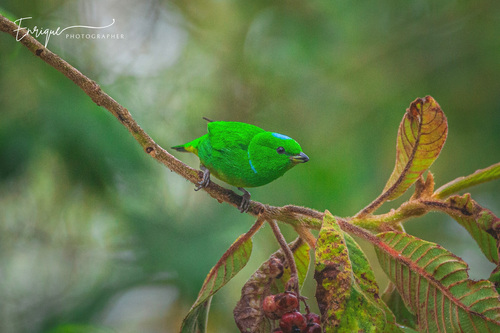
Blue-crowned Chlorophonia
Chlorophonia occipitalis
Meet the 'emerald of the cloud forest,' a stunning songbird with a brilliant turquoise crown and a golden-yellow belly. A highland specialist, the Blue-crowned Chlorophonia is a master of disguise in the lush Central American canopy.
Quick Identification
Size
12-13 cm (4.7-5.1 inches) in length; weight 18-25 g (0.6-0.9 oz)
Colors
Primary lime-green plumage. Males have a turquoise-blue crown and hindneck collar with bright yellow underparts. Females are similar but with duller yellowish-green bellies and a smaller blue crown patch.
Key Features
- Vivid lime-green plumage
- Brilliant turquoise-blue patch on the crown
- Deep golden-yellow belly and chest on males
- Short, stubby bill and compact, short-tailed build
When You’ll See Them
Geographic range
Where Does the Blue-crowned Chlorophonia Live?
Native to the highlands of Central America and southern Mexico, the Blue-crowned Chlorophonia thrives in the humid, mist-shrouded montane regions. Its core range extends from the Sierra Madre de Chiapas in Mexico through the highlands of Guatemala, Honduras, El Salvador, and Nicaragua, reaching its southern limit in the mountains of northern Panama. These birds are year-round residents of these cool, high-altitude forests, following the seasonal ripening of fruit within their narrow altitudinal belt.
Basemap © OpenStreetMap contributors
Behavior
The Blue-crowned Chlorophonia is a social but often elusive bird, typically seen in pairs or small family groups high within the canopy of cloud forests. Despite their brilliant colors, they can be remarkably difficult to spot against the lush green foliage as they move methodically through the treetops. They are known for their quiet, high-pitched whistling calls that often give away their presence before they are seen by observers on the ground.
These birds are primarily canopy-dwellers and rarely descend to the forest floor. They exhibit a specialized feeding behavior, often hanging acrobatically to reach small fruits or mistletoe berries. While they aren't traditionally 'backyard birds' in the suburban sense, they frequent fruit-producing trees in gardens and shade-grown coffee plantations near forested areas, where they show a tolerance for human presence if the habitat remains intact.
EverydayEarth exclusive
Camera Tips
To capture the Blue-crowned Chlorophonia, camera placement is everything. Since these birds are canopy specialists, mounting your AI-powered camera on a high-reaching tripod or securely on a branch in a fruit-bearing tree is essential. Focus on trees with mistletoe clumps or small, berry-like fruits, as these are their primary draw. Aim the camera at a 45-degree downward angle if you can mount it above a fruiting cluster to capture the bird's brilliant blue crown—the most distinctive feature from above.
If you are in a highland area where these birds are present, setting up a specialized fruit feeder can bring them lower. Use sliced bananas, plantains, or native berries to lure them into the camera's field of view. Because they are active early in the morning when the cloud forest is still misty, ensure your camera is set to a high-sensitivity mode or use a model with excellent low-light performance to avoid blurry shots in the low morning light.
Trigger speed is crucial for these small, fast-moving birds. Set your camera to a 'burst' or 'rapid-fire' mode to catch the perfect pose while they are acrobatically hanging from a branch. Since they often travel in pairs, a wider field of view might allow you to capture both the brightly colored male and the more demure female in a single frame. Seasonal timing is less critical than daily timing; however, during the nesting season (typically March through July), they may be more focused on specific foraging routes, providing more consistent capture opportunities.
Similar Species
Species that look similar or are commonly confused with Blue-crowned Chlorophonia.
Frequently Asked Questions
Record Blue-crowned Chlorophonia at your habitat
Connect a camera to start building your own species record — AI identifies every visitor automatically.