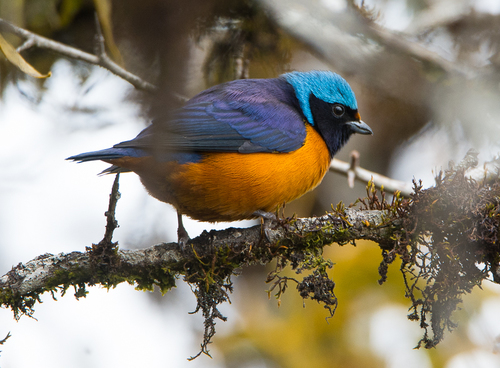
Elegant Euphonia
Chlorophonia elegantissima
Adorned with a striking sky-blue hood and rich golden plumage, the Elegant Euphonia is a jewel of the Central American highlands. This specialized berry-eater brings a splash of brilliant color to forest edges and mountain gardens alike.
Quick Identification
Size
10-11 cm (4-4.3 inches) in length; weighs approximately 13-17 grams (0.45-0.6 ounces)
Colors
Males have a brilliant sky-blue crown and nape, dark violet-blue upperparts, and a rich tawny-orange belly. Females are primarily olive-green with the same distinctive blue hood.
Key Features
- Bright sky-blue 'hood' covering the crown and nape
- Stubby, dark bill typical of finches
- Male: Dark throat and tawny-underparts; Female: Uniform yellow-green body
- Frequent association with mistletoe plants
When You’ll See Them
Geographic range
Where Does the Elegant Euphonia Live?
The Elegant Euphonia is native to the highland regions of North and Central America. Its core range extends from the mountains of northern Mexico down through Guatemala, Belize, El Salvador, Honduras, and Nicaragua, reaching its southern limit in the central highlands of Costa Rica and western Panama. This species is largely a resident throughout its range, though some populations may move to lower elevations during the cooler winter months in search of food.
Basemap © OpenStreetMap contributors
Behavior
The Elegant Euphonia is a lively and social finch, usually found in pairs or small family groups moving through the upper canopy. They are exceptionally specialized feeders, having evolved a digestive system specifically designed to handle mistletoe berries. Their flight is rapid and undulating, often accompanied by soft, metallic 'peep' or 'chut' calls that help birdwatchers locate them in dense foliage.
These birds are not particularly shy and can often be found in suburban gardens or coffee plantations that maintain mature shade trees. They are known for their 'restless' nature, rarely staying in one spot for long as they search for ripe fruit. Despite their small size, they are hardy birds of the highlands and are often seen interacting peacefully with other fruit-eating species like tanagers and honeycreepers.
EverydayEarth exclusive
Camera Tips
To successfully capture an Elegant Euphonia on your AI camera, the most critical factor is the presence of mistletoe. These birds are obligate mistletoe eaters; find a tree with these parasitic clumps, and you will almost certainly find the bird. Mount your camera at a height that looks directly into the mid-to-upper canopy where mistletoe typically grows, rather than at ground level.
Since these birds have vibrant, reflective blue plumage, morning light is your best friend. Position your camera facing north or south to avoid harsh direct backlight, which can wash out the brilliant 'blue hood' that gives the bird its name. A camera with a fast trigger speed is essential, as Euphonias are energetic and rarely sit still for more than a few seconds while feeding.
Water is another excellent lure for this species. While they may not visit traditional seed feeders, they are frequently drawn to the sound of moving water for bathing and drinking. A birdbath with a solar-powered dripper or a small fountain located near the edge of a wooded area is a high-traffic zone for Euphonias. If you are setting up a trail camera, focus on gaps in the forest edge where they cross from deep cover into more open fruiting trees.
Similar Species
Species that look similar or are commonly confused with Elegant Euphonia.
Blue-crowned Chlorophonia
Larger with a much greener body and a shorter tail; lacks the tawny-orange underparts of the male Elegant Euphonia.
Scrub Euphonia
Lacks the blue hood; males have a yellow forehead and dark navy crown.
Yellow-throated Euphonia
Found at lower elevations; males have a yellow throat and no blue on the head.
Frequently Asked Questions
Record Elegant Euphonia at your habitat
Connect a camera to start building your own species record — AI identifies every visitor automatically.