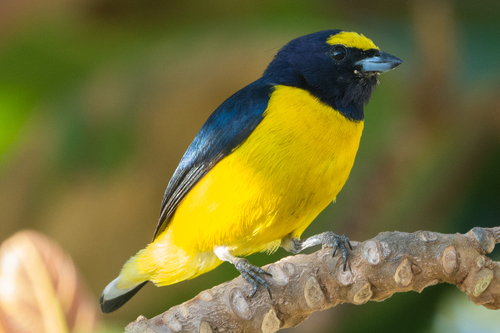
Scrub Euphonia
Euphonia affinis
A tiny gem of the tropical scrub, the Scrub Euphonia delights backyard observers with its vibrant yellow plumage and cheerful, whistling song. These energetic finches are masters of the canopy, bringing a splash of color and life to garden edges and forest borders.
Quick Identification
Size
Length: 3.5-4 inches (9-10 cm); Weight: 0.3-0.4 oz (8.5-11 g)
Colors
Males have glossy blue-black upperparts with a bright yellow forehead and belly. Females are olive-green above and pale grayish-yellow below.
Key Features
- Stubby, thick dark bill
- Male has a bright yellow forehead patch that stops above the eye
- Blue-black throat on males (separating them from Yellow-throated cousins)
- Small, compact, almost tail-less appearance
When You’ll See Them
Behavior
The Scrub Euphonia is a charismatic and energetic little finch often found in pairs or small family groups. They are best known for their constant movement and vocal nature, frequently emitting a series of high-pitched, melodic whistles and chips as they forage. Unlike many other songbirds, they are gifted mimics, often incorporating the calls of other birds into their own songs to create a complex auditory tapestry.
These birds are highly social and are frequently seen joining mixed-species foraging flocks, particularly around fruiting trees. While they are relatively comfortable around human-altered landscapes like suburban gardens and coffee plantations, they spend much of their time in the mid-to-upper canopy. Their social structure is usually monogamous, and both parents are often seen working together to find food for their young during the nesting season.
EverydayEarth exclusive
Camera Tips
To capture the Scrub Euphonia on an AI-powered camera, you must think vertically. These birds rarely descend to the ground, so mounting your camera at least 5 to 8 feet high is essential. If you have a fruiting tree in your yard—especially one with mistletoe—place the camera on a branch with a clear line of sight to the berry clusters. A 'perch-style' camera mount works wonders here, as it allows the bird to land comfortably within the focal range of the lens.
Water is a massive draw for Euphonias, but they prefer elevated baths over traditional ground-level basins. Try placing a shallow ceramic dish on a pedestal or hanging a birdbath near thick cover. If your camera has a motion-trigger sensitivity setting, keep it high; these birds move in quick, jerky bursts and can easily be missed by slower sensors. Ensure the sun is behind the camera in the morning hours to highlight the iridescent blue-black feathers of the male.
While they don't typically visit standard seed feeders, you can 'bait' your camera area using fresh fruit. Skewer half a banana or a slice of orange to a branch near your camera lens. The scent and bright colors of the fruit will act as a visual lure. For the best results, use a high shutter speed setting if your camera allows it, as their constant tail-flicking and head-turning can cause motion blur in lower light conditions.
Similar Species
Species that look similar or are commonly confused with Scrub Euphonia.
Frequently Asked Questions
Record Scrub Euphonia at your habitat
Connect a camera to start building your own species record — AI identifies every visitor automatically.