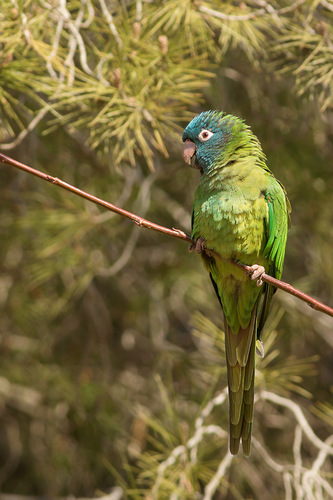
Blue-crowned Parakeet
Thectocercus acuticaudatus
A social and vocal parrot of the Americas, the Blue-crowned Parakeet is famous for its brilliant turquoise forehead and its remarkable ability to adapt to urban life.
Quick Identification
Size
Length 14–15 inches (35–38 cm), wingspan 24 inches (61 cm), weight 5–6.7 oz (140–190 g)
Colors
Bright green body with a turquoise-blue forehead and crown; horn-colored upper beak and black lower beak
Key Features
- Vibrant blue forehead and crown
- Pale horn-colored upper mandible
- Long, tapered tail with reddish undersides
- Bold white eye-ring around orange eyes
When You’ll See Them
Geographic range
Where Does the Blue-crowned Parakeet Live?
Native to South America, the Blue-crowned Parakeet calls home a wide range of territories from eastern Colombia and Venezuela through the heart of Brazil to northern Argentina and Paraguay. They generally prefer open landscapes and deciduous woodlands, carefully avoiding the dense interior of the Amazon basin. Beyond their native lands, thriving introduced populations have become a staple of the urban wildlife in parts of the United States, most notably in Southern California and Florida.
Basemap © OpenStreetMap contributors
Behavior
In urban and suburban environments, these parakeets have proven remarkably resilient and adaptable. They often form communal roosts in tall trees or palm fronds, departing in a synchronized burst of green at dawn. They display a playful temperament and can often be seen hanging upside down to reach fruit or engaging in lighthearted 'wrestling' matches with flock mates on garden fences and feeders.
EverydayEarth exclusive
Camera Tips
Baiting is very effective for this species. They are highly attracted to black oil sunflower seeds, safflower seeds, and halved fresh fruits like oranges or apples. If you have a fruiting tree like a loquat or a palm with ripe berries, place your camera nearby during the ripening season. They are creatures of habit, so once you record a visit, expect them to return at roughly the same time the following day.
For camera settings, use a fast trigger speed to account for their quick, jerky movements. High-definition video (1080p or higher) is recommended to capture the subtle maroon flashes in their tail feathers during flight. If your camera supports it, set a 'cooling-down' period of only a few seconds between captures, as the arrival of one bird usually means ten more are right behind it.
Similar Species
Species that look similar or are commonly confused with Blue-crowned Parakeet.
Frequently Asked Questions
Record Blue-crowned Parakeet at your habitat
Connect a camera to start building your own species record — AI identifies every visitor automatically.