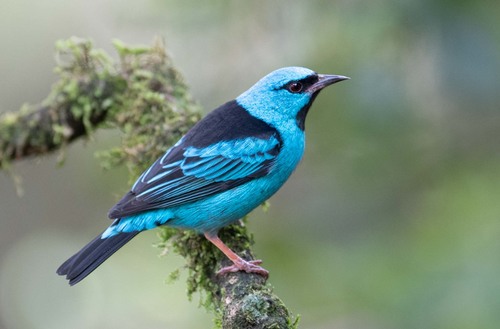
Blue Dacnis
Dacnis cayana
A shimmering jewel of the tropical canopy, the Blue Dacnis brings a splash of brilliant turquoise to the forest. This social and energetic tanager is a master of the treetops, flitting through the leaves in vibrant mixed flocks.
Quick Identification
Size
Length: 12-13 cm (4.7-5.1 in); Weight: 11-15 g (0.4-0.5 oz)
Colors
Males are a brilliant turquoise-blue with a black throat, back, and wings. Females are primarily lime-green with a blue-tinted head.
Key Features
- Vibrant turquoise plumage in males
- Black triangular mask around the eyes
- Sharp, slightly curved black bill
- Distinctive reddish-pink iris
When You’ll See Them
Sightings on EverydayEarth
Jun 27, 2026
A bustling morning at the fruit feeder sees several species arriving to feed. A Clay-colored Thrush occupies the center of the tray, while a Blue-gray Tanager and a vibrant turquoise Blue Dacnis hop between orange halves. A small Thick-billed Euphonia also joins the group, quickly picking at the fruit before moving off.
Mar 30, 2026
A male Blue Dacnis is seen feeding on halved citrus fruits on the feeder platform. A female Blue Dacnis briefly perches on a mossy branch just above the fruit before hopping out of view. Moments later, a Clay-colored Thrush lands on the right side of the platform to join the male dacnis at the feeder.
Geographic range
Where Does the Blue Dacnis Live?
Native to the lush Neotropics, the Blue Dacnis occupies a vast territory stretching from Central America down through the heart of South America. Its journey begins in Nicaragua and extends through Panama into the Amazon basin, reaching as far south as Bolivia and northern Argentina. It is also a common sight on the island of Trinidad, making it one of the most widespread turquoise birds in the Western Hemisphere.
Basemap © OpenStreetMap contributors
Behavior
The Blue Dacnis is a high-energy member of the tanager family, known for its restless nature and preference for the upper layers of the forest. They are intensely social birds, often serving as core members of mixed-species foraging flocks. You will frequently see them traveling alongside honeycreepers, warblers, and other tanagers, moving quickly from branch to branch in search of food.
In the wild, they are canopy specialists, which can make them difficult to spot from the ground. However, they are quite curious and will descend to lower levels at the forest edge or in gardens to investigate food sources. Their flight is direct and fast, and they communicate with thin, high-pitched call notes that can be heard even in a noisy forest environment.
EverydayEarth exclusive
Camera Tips
Capturing the Blue Dacnis on a backyard camera requires thinking vertically. Since these birds are canopy dwellers, a camera mounted at eye level or on a standard fence post might miss them entirely. For the best results, place your AI-powered camera on a balcony, a high tree limb, or a tall pole overlooking the mid-canopy. If you have flowering trees like Erythrina or fruiting Cecropia nearby, aim your lens toward the outer branches where they are most likely to forage.
To bring these 'jewels of the canopy' down to camera range, high-value lures are essential. They are particularly attracted to sweet, overripe fruits. Try mounting halved oranges, bananas, or papayas on a platform feeder. Unlike many other birds, they will often return to the same fruit source daily once they discover it. Ensure the feeder is in a relatively open spot near cover, as they can be shy when descending from the treetops.
Lighting is the most critical factor for getting a high-quality capture of the male's iridescent blue. Try to position your camera so the sun is behind it during peak morning hours. Direct light hitting the feathers will reveal the stunning turquoise shimmer; otherwise, the bird may appear as a dark, unidentifiable silhouette. Use a high-sensitivity motion trigger or a short-interval burst mode, as their movements are incredibly fast and they rarely sit still for more than a few seconds.
Similar Species
Species that look similar or are commonly confused with Blue Dacnis.
Frequently Asked Questions
Record Blue Dacnis at your habitat
Connect a camera to start building your own species record — AI identifies every visitor automatically.