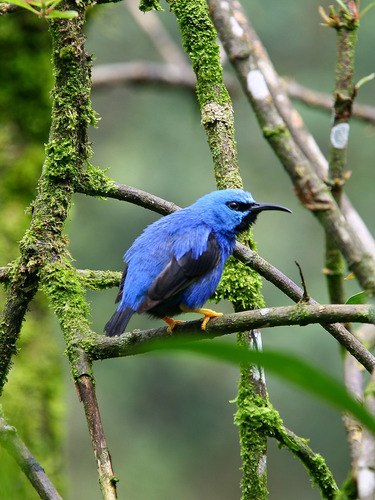
Shining Honeycreeper
Cyanerpes lucidus
A vibrant jewel of the Central American canopy, the Shining Honeycreeper is best known for its electric indigo feathers and its surprisingly bright yellow legs. This tiny, active tanager brings a flash of tropical brilliance to any backyard camera setup.
Quick Identification
Size
Length: 10–11 cm (4 in); Weight: 10–12 g (0.35–0.42 oz)
Colors
Males are a deep indigo-blue with black wings, tail, and throat patch; females are grass-green above and buffy with blue-green streaks below. Both sexes feature strikingly bright yellow legs.
Key Features
- Bright, lemon-yellow legs and feet
- Long, slender, decurved black bill
- Male has indigo plumage with a distinct black throat patch
- Small, active tanager with a short tail
When You’ll See Them
Behavior
The Shining Honeycreeper is a high-energy socialite of the tropical canopy. Often found in pairs or small family groups, these birds are restless foragers that move rapidly through the treetops. While they are primarily canopy dwellers, they are surprisingly bold and will frequently descend to forest edges or garden clearings if there is a reliable source of nectar or fruit. They are known to join mixed-species foraging flocks, trailing after other tanagers and honeycreepers in search of a meal.
In their interactions with humans, they are generally tolerant but move too quickly for most casual observers to get a good look without binoculars. They communicate with high-pitched, thin 'tsip' calls that can be difficult to hear over the rustle of the forest. Despite their delicate appearance, they are territorial around prime feeding spots and will occasionally chase off smaller competitors from a preferred flowering tree.
EverydayEarth exclusive
Camera Tips
To capture the Shining Honeycreeper on camera, height is your greatest advantage. Because these birds spend most of their time in the upper layers of the forest, placing your camera on a second-story balcony or mounting it high in a tree overlooking a garden will yield much better results than ground-level setups. Aim your lens toward flowering trees like Erythrina or Inga, which act as natural magnets for this species. If you are using a feeder, ensure it is positioned in a spot that receives bright, indirect sunlight; direct midday sun can wash out the male's deep indigo iridescence, making him look black in photos.
Baiting is highly effective for this species. They are particularly fond of overripe bananas and plantains. You can use a 'fruit spike' or a platform feeder to secure the fruit, preventing larger birds from carrying it away. If your camera supports AI triggers, set it to detect 'small birds' and use a fast shutter speed (at least 1/1000s) or a high-frame-rate video mode. These birds rarely sit still for more than a second or two, so a slow trigger will result in a gallery of blurry blue wings.
Consider the background of your shot. Since the Shining Honeycreeper has those iconic yellow legs, try to use a perch that is a contrasting dark wood or a vibrant green branch to make the colors pop. If you are in a dry spell, a misting system or a dripping water feature near your camera can be an irresistible draw. They love to bathe in the fine spray of a mister, providing a rare opportunity to capture them in a stationary, relaxed state rather than their usual frantic foraging mode.
Similar Species
Species that look similar or are commonly confused with Shining Honeycreeper.
Purple Honeycreeper
The Purple Honeycreeper male is a deeper violet-purple and lacks the extensive black bib found on the Shining Honeycreeper.
Red-legged Honeycreeper
Easily distinguished by their bright red legs and the male's turquoise crown, which the Shining Honeycreeper lacks.
Blue Dacnis
Has a shorter, straight bill and lacks the bright yellow legs; the male has a black mask rather than a full black throat.
Frequently Asked Questions
Record Shining Honeycreeper at your habitat
Connect a camera to start building your own species record — AI identifies every visitor automatically.