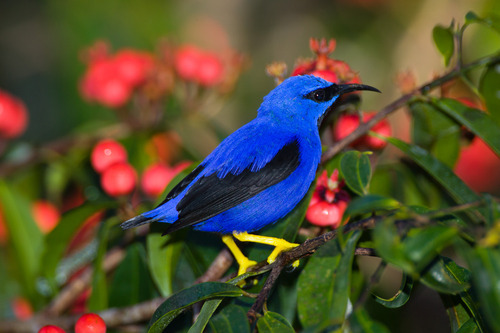
Purple Honeycreeper
Cyanerpes caeruleus
A shimmering jewel of the tropical canopy, the Purple Honeycreeper dazzles with its indigo feathers and signature yellow legs. Watch as these acrobatic nectar-seekers bring a burst of vibrant color to garden feeders and forest edges alike.
Quick Identification
Size
Length: 4.5 inches (11.5 cm); Weight: 0.42 oz (12 g); Wingspan: 6-7.5 inches (15-19 cm)
Colors
Males are deep indigo-purple with black wings, tail, and throat patch; females are bright grass-green with buff-colored, dark-streaked underparts.
Key Features
- Bright yellow legs and feet
- Long, slender, decurved black bill
- Vibrant purple body with black 'mask' and throat (males)
- Pale blue 'moustachial' stripe (females)
When You’ll See Them
Behavior
The Purple Honeycreeper is an incredibly active and social tanager, known for its high-energy movements through the upper layers of the forest. They are often seen in small groups or as part of larger, mixed-species flocks, moving quickly from flower to flower. They possess a specialized, brush-tipped tongue that allows them to efficiently lap up nectar, but they are also quite acrobatic, frequently hanging upside down to reach the underside of tropical blooms or to glean small insects from the foliage.
In backyard settings within their range, they are relatively bold and will readily visit bird tables and nectar feeders. Unlike some more territorial species, Purple Honeycreepers are generally peaceful, though they will engage in quick, chirping chases with others of their kind during peak feeding times. Their flight is characterized by rapid, direct wingbeats, often moving in a 'follow-the-leader' fashion through the canopy.
EverydayEarth exclusive
Camera Tips
To capture the best images of the Purple Honeycreeper, camera height is your most important variable. These are primarily canopy birds, so mounting your AI camera at eye level (5-7 feet) near a food source is essential. Avoid ground-level placement as they rarely descend to the floor. Positioning your camera near flowering plants like Heliconia or specialized nectar feeders will provide the most consistent results. If using a feeder, try to find a camera angle that captures the bird from the side to showcase the elegant curve of its bill.
Lighting is the biggest challenge when photographing the male's deep purple plumage. In low light, they can appear almost black or dark blue. Set your camera in an area that receives dappled morning sunlight, which will catch the iridescence of their feathers without blowing out the highlights. If your camera allows for shutter speed adjustments, keep it fast; these birds are constant movers and rarely sit still for more than a few seconds. A 'Burst Mode' or high-frame-rate video setting is highly recommended to catch their rapid movements.
Baiting with fruit is a highly effective strategy for backyard cameras. Halved oranges or ripe bananas secured to a branch are irresistible to honeycreepers. To get the most 'natural' look, drill a small hole in a piece of driftwood or a decorative branch and hide a small nectar cup inside it. This encourages the bird to land on a photogenic perch rather than a plastic feeder, providing you with high-quality, professional-looking wildlife captures. Finally, because they live in humid environments, ensure your camera has a fresh desiccant pack inside the housing to prevent lens fogging during the early morning hours when activity peaks.
Similar Species
Species that look similar or are commonly confused with Purple Honeycreeper.
Red-legged Honeycreeper
Look for bright red legs and a turquoise crown on the male, which the Purple Honeycreeper lacks.
Short-billed Honeycreeper
Has a significantly shorter, straighter bill and lacks the black throat patch found on the male Purple Honeycreeper.
Green Honeycreeper
The male is a uniform aqua-green rather than purple, and both sexes have a much heavier, bicolored bill.
Frequently Asked Questions
Record Purple Honeycreeper at your habitat
Connect a camera to start building your own species record — AI identifies every visitor automatically.