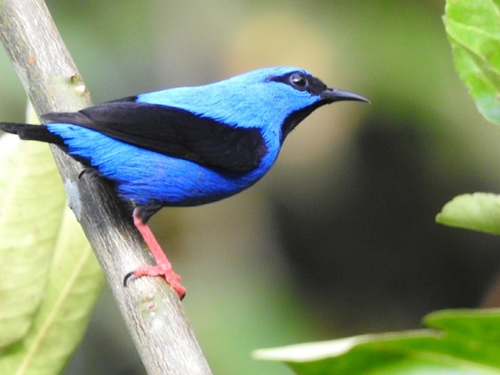
Short-billed Honeycreeper
Cyanerpes nitidus
A miniature marvel of the Amazonian canopy, the Short-billed Honeycreeper dazzles with its electric blue plumage and striking red legs. This tiny, high-energy nectar seeker is a prized find for any backyard camera enthusiast in the tropics.
Quick Identification
Size
Length: 10 cm (4 inches); Wingspan: 15–18 cm (6–7 inches); Weight: 8–10 g (0.28–0.35 oz)
Colors
Males are a brilliant electric blue with black wings, tail, and throat patch; they are distinguished by bright pinkish-red legs. Females are forest green above and pale/buffy with fine green streaks below.
Key Features
- Short, slightly decurved black bill
- Vibrant pinkish-red legs and feet on males
- Black throat patch and eye mask in males
- Small, compact honeycreeper silhouette
- Faint yellowish-green streaking on the breast of females
When You’ll See Them
Behavior
The Short-billed Honeycreeper is an energetic and restless inhabitant of the tropical forest canopy. These birds are rarely seen alone, usually moving in pairs or small family groups. They are also frequent participants in mixed-species foraging flocks, traveling alongside other tanagers, dacnis, and even wood-warblers as they move through the upper layers of the forest in search of food.
Unlike some of their bolder relatives, Short-billed Honeycreepers can be somewhat shy, preferring to stay high in the trees where they perform acrobatic maneuvers to reach nectar or insects on the underside of leaves. They are highly social with their own kind and use a series of thin, high-pitched call notes to keep the group together as they flit rapidly from one flowering tree to the next. In areas where fruit or nectar is abundant, they may linger for several minutes, providing a rare opportunity for close observation.
EverydayEarth exclusive
Camera Tips
Capturing the Short-billed Honeycreeper requires moving your camera off the ground. These are canopy-dwelling birds, so a camera mounted at eye level or higher (10–15 feet) looking toward a flowering tree or a high-mounted feeder is essential. If you have a balcony or an elevated deck overlooking a garden, this is the perfect place to mount your AI-powered camera. Angle the lens slightly downward to ensure you catch the iridescent blue of the male's crown and back.
To lure them into view, provide a nectar feeder that includes perches; unlike hummingbirds, honeycreepers generally prefer to sit while they feed. A high-concentration sugar-water mix (1 part sugar to 4 parts water) or halved oranges and overripe bananas will act as a powerful magnet. Because these birds are small and move with sudden, jerky motions, set your camera to its highest possible frame rate or use a 'burst' photo mode to avoid motion blur during their frequent hops.
Light is your best friend when trying to identify this species. To distinguish the Short-billed from the very similar Purple Honeycreeper, you need to see the leg color and bill length clearly. Position your camera so the morning sun is behind the lens, illuminating the bird’s plumage. If your camera allows for zone-based triggering, focus the trigger area specifically on the perches of your feeder to ensure the AI captures every visit without being distracted by moving leaves in the background.
Similar Species
Species that look similar or are commonly confused with Short-billed Honeycreeper.
Purple Honeycreeper
The Purple Honeycreeper has a significantly longer bill and bright yellow legs, whereas the Short-billed has red legs.
Red-legged Honeycreeper
Red-legged Honeycreepers are larger with a bright turquoise crown and a much more prominent black mask.
Blue Dacnis
The Blue Dacnis has a thicker, straighter bill and the male lacks the black throat patch found on the Short-billed Honeycreeper.
Frequently Asked Questions
Record Short-billed Honeycreeper at your habitat
Connect a camera to start building your own species record — AI identifies every visitor automatically.