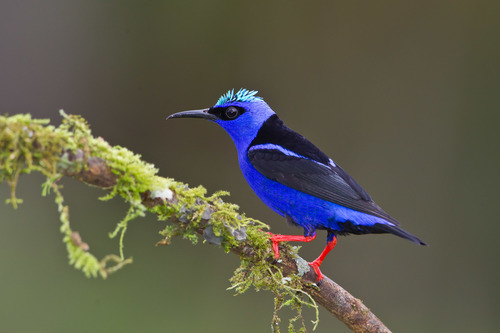
Red-legged Honeycreeper
Cyanerpes cyaneus
A living jewel of the tropical canopy, the Red-legged Honeycreeper dazzles with its electric blue plumage and iconic crimson boots. These agile nectar-seekers are a high-speed highlight for any backyard observer.
Quick Identification
Size
Length: 12-13 cm (4.7-5.1 in); Weight: 10-16 g (0.35-0.56 oz)
Colors
Males are a vivid violet-blue with a turquoise crown, black eye mask, and black wings/tail. Females are olive-green with pale, streaked underparts. Both feature namesake bright red legs.
Key Features
- Bright scarlet-red legs and feet
- Long, slender, slightly curved black bill
- Male: Brilliant turquoise 'cap' contrasting with deep violet body
- High-pitched, thin 'tsip' calls
When You’ll See Them
Behavior
Red-legged Honeycreepers are exceptionally active and social songbirds, often moving in small family groups or joining mixed-species flocks as they forage through the canopy. They are high-energy birds, rarely staying in one spot for more than a few seconds as they dart between flowers and fruit clusters. Their flight is direct and swift, punctuated by frequent vocalizations that help the group stay together in dense foliage.
In the garden or backyard setting, they are bold explorers. While they primarily stay in the upper levels of the trees, they will readily descend to nectar feeders or fruit platforms if they feel secure. Their interaction with humans is generally indifferent; they are not particularly skittish but will maintain a watchful distance, relying on their speed to escape any perceived threats.
EverydayEarth exclusive
Camera Tips
To capture the stunning violet-blue of the male Red-legged Honeycreeper, camera placement is everything. These birds are canopy-dwellers by nature, so mounting your camera 6 to 10 feet off the ground near a flowering tree or a specialized nectar feeder will yield much better results than a ground-level setup. Angle the camera slightly downward to ensure the bright red legs—their most distinctive feature—are visible against the plumage.
Baiting is highly effective for this species. They are particularly fond of sliced oranges, softened bananas, and high-quality hummingbird nectar. If using a nectar feeder, choose one with a perch, as honeycreepers prefer to sit while drinking rather than hover like hummingbirds. Placing the feeder in a spot that receives dappled morning sunlight will help the camera sensor pick up the iridescent sheen of their feathers without blowing out the highlights.
Because these birds move with incredible speed, use a camera with a fast trigger speed (0.2 seconds or less) and a high frame rate. A 'burst mode' setting is ideal for catching the moment they flare their wings or interact with other birds at the feeder. If your camera allows for shutter speed adjustment, keep it high to avoid motion blur during their quick, erratic movements.
Lastly, consider the background. Red-legged Honeycreepers look most spectacular against a dark green, out-of-focus foliage background. Position your camera so it isn't pointing directly into the sun, which can wash out the deep blues of the male. Early morning (just after sunrise) provides the best 'golden hour' light that makes their turquoise caps and red legs truly pop on screen.
Similar Species
Species that look similar or are commonly confused with Red-legged Honeycreeper.
Purple Honeycreeper
Features bright yellow legs and a longer, more curved bill; lacks the turquoise cap of the Red-legged male.
Shining Honeycreeper
Distinguished by bright yellow legs and more extensive black on the throat and wings.
Blue Dacnis
Has a shorter, stouter bill and lacks the brilliant red legs, usually possessing pinkish-grey feet.
Frequently Asked Questions
Record Red-legged Honeycreeper at your habitat
Connect a camera to start building your own species record — AI identifies every visitor automatically.